
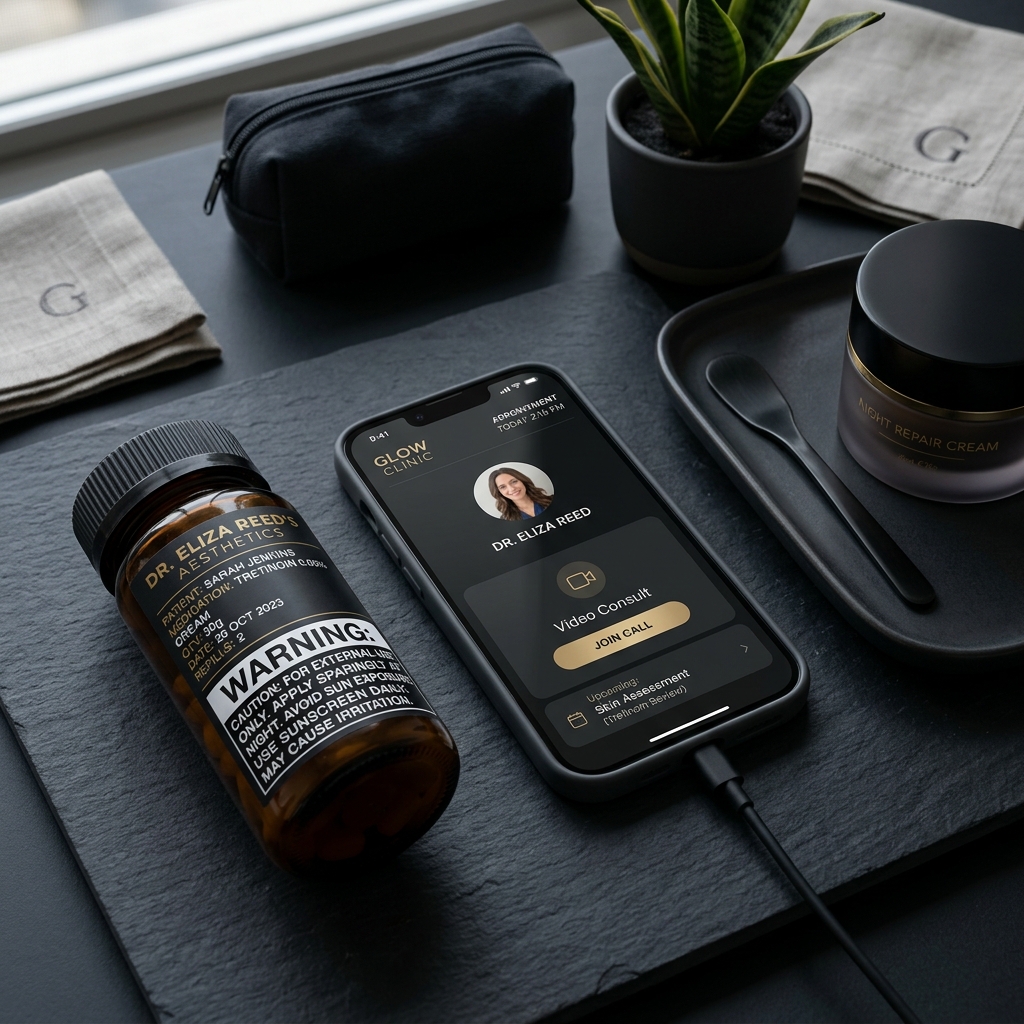
Because brand-name Wegovy and Ozempic are frequently in short supply, the FDA permits state-licensed compounding pharmacies to produce semaglutide. This legal loophole has allowed millions of Americans to access affordable weight loss medication without battling their insurance companies.
Unfortunately, it has also spawned a massive, unregulated black market. Medical spas, predatory websites, and offshore pharmacies are aggressively marketing illegal or unsafe knockoffs to desperate consumers. If you are exploring telehealth options, you must protect yourself by looking out for these 7 red flags.
If you want to bypass the sketchy websites entirely, you can access vetted, PCAB-accredited pharmacies through Telehealth FX.
1. "Semaglutide Sodium" or "Acetate"
The FDA has issued explicit, severe warnings that the salt forms of semaglutide (sodium and acetate) have not been shown to be safe and effective. True compounded semaglutide must use the pure "base" molecule. If a pharmacy's label, website, or customer support mentions "sodium," do not inject it. It is illegal for a compounding pharmacy to use these salts.
2. "Research Grade" Disclaimers
If a website sells vials of semaglutide with a disclaimer stating "For Research Purposes Only" or "Not for Human Consumption," they are bypassing FDA regulations entirely. These are peptide supply companies, not pharmacies. Injecting research-grade peptides is incredibly dangerous, as they are not manufactured in sterile cleanrooms and are frequently contaminated with endotoxins that can cause sepsis.
3. No Telehealth Consultation Required
Semaglutide is a prescription-only medication. Period. If a website allows you to add a vial of semaglutide to your digital cart and check out with a credit card without speaking to, messaging, or exchanging medical intake forms with a licensed doctor or nurse practitioner, it is an illegal operation. They are essentially drug trafficking.
Don't Gamble with Your Health
TelehealthFX rigorously vets every pharmacy partner. We only work with PCAB-accredited, U.S.-based 503A and 503B compounding pharmacies that use pure semaglutide base.
Get Safe, Vetted GLP-1s4. Refusal to Provide a COA
A Certificate of Analysis (COA) is a document from an independent, third-party testing laboratory that verifies the purity and potency of the medication batch. Legitimate telehealth platforms and pharmacies will gladly provide a COA upon request. If they refuse, make excuses, or say it's "proprietary," assume the medication is adulterated or severely under-dosed.
5. The Price is "Too Good to Be True"
The raw Active Pharmaceutical Ingredient (API) for semaglutide base is expensive. Furthermore, legitimate 503A pharmacies spend millions maintaining sterile cleanrooms, hiring specialized compounding pharmacists, and running third-party tests. If a provider is offering compounded semaglutide for $99 a month, they are either cutting corners on sterility, using illegal salt forms, or operating a bait-and-switch billing scheme.
The MedSpa Markup
Conversely, be wary of local medical spas charging $800+ for compounded semaglutide. They are buying the exact same $150-$200 vials from the same compounding pharmacies that telehealth companies use, and marking them up 400% simply because they hand you the needle in person.
6. Shipped Warm in the Summer
Compounded semaglutide is a delicate peptide string. While it can survive at room temperature for brief periods, a legitimate pharmacy will always ship the medication overnight or via 2-day air, packed tightly with medical-grade ice packs. If your vial arrives hot to the touch in July via standard 5-day mail, the peptides may have degraded, rendering the medication useless.
7. No Pharmacy Accreditation
Always ask your telehealth provider which specific pharmacy will be fulfilling your prescription. Once you have the name, check their website. Are they PCAB (Pharmacy Compounding Accreditation Board) accredited? Are they licensed in your state? PCAB accreditation means the pharmacy voluntarily submits to standards far stricter than basic state laws.
Trust the Process.
We remove the guesswork. TelehealthFX connects you with board-certified clinicians and ships direct from strictly vetted U.S. pharmacies.
Start Your Intake