
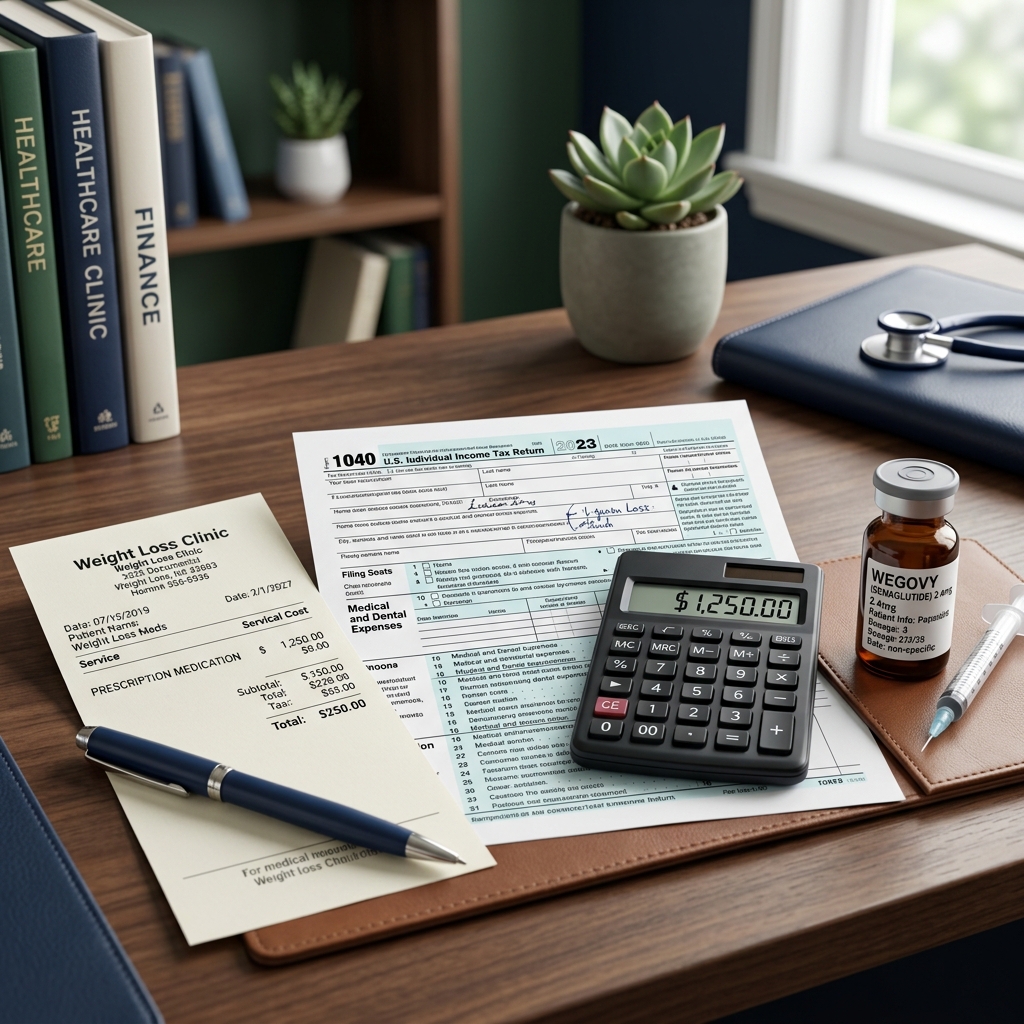
If you are paying $199–$499/month out-of-pocket for compounded GLP-1 medication, you may be able to recover 20–37% of those costs through HSA/FSA accounts, medical expense tax deductions, or both. Over a year of treatment, this can save $500–$2,000+. Here is exactly how — and what documentation you need.
Three Ways to Reduce Your Effective GLP-1 Cost
| Method | Tax Savings | Effective Monthly Cost ($199) | Requirements |
|---|---|---|---|
| HSA/FSA | 22–37% | $125–$155 | Active HSA/FSA account |
| Schedule A deduction | 12–37% | $125–$175 | Itemize + exceed 7.5% AGI |
| Self-employed deduction | 22–37% | $125–$155 | Self-employed or 1099 income |
Method 1: HSA/FSA (Pre-Tax Dollars)
This is the simplest and most impactful way to reduce your GLP-1 cost. We cover this in depth in our complete HSA/FSA guide, but here is the summary:
- How it works: HSA and FSA contributions are pre-tax — money goes in before income tax, Social Security tax, and Medicare tax are calculated. When you pay for GLP-1 with these funds, you effectively reduce the cost by your marginal tax rate.
- Is GLP-1 eligible? Yes. Prescription medication for a diagnosed medical condition (obesity, BMI 30+, or BMI 27+ with comorbidity) is an eligible expense under IRS Publication 502.
- The math: At a 24% federal tax bracket + 7.65% FICA = ~32% effective savings. $199/month becomes ~$135/month in after-tax terms. At the 37% bracket, your effective cost drops to ~$125/month.
- 2026 HSA contribution limits: $4,300 (individual) or $8,550 (family). This covers your full GLP-1 cost and then some.
Method 2: Medical Expense Deduction (Schedule A)
If your total qualified medical expenses exceed 7.5% of your adjusted gross income (AGI), the excess is deductible as an itemized deduction:
- AGI $60,000: 7.5% threshold = $4,500. If your total medical expenses (GLP-1 + everything else) exceed $4,500, the excess is deductible.
- GLP-1 alone: At $199/month, that is $2,388/year. Combined with insurance premiums, dental work, vision, other prescriptions, and doctor visits, many households exceed the threshold.
- What qualifies: The medication itself, telehealth consultation fees, shipping costs for medication, supplies (syringes, alcohol swabs), and any related lab work ordered by your clinician.
- Key requirement: You must itemize deductions (Schedule A) rather than taking the standard deduction. This is advantageous only if your total itemized deductions exceed $14,600 (single) or $29,200 (married filing jointly) for 2026.
Method 3: Self-Employed Health Deduction
Self-employed individuals (sole proprietors, LLC members, 1099 contractors, S-corp owners) have an additional advantage:
- Above-the-line deduction: Health insurance premiums and qualifying medical expenses can be deducted on Schedule 1 — you do not need to itemize. This reduces AGI directly.
- How GLP-1 qualifies: If your GLP-1 is prescribed as part of your medical care and you are not eligible for employer-subsidized insurance, the cost is deductible against your business income.
- Tax savings: Self-employment income is subject to both income tax AND self-employment tax (15.3%). The deduction saves you on both, making it even more valuable than W-2 employee HSA contributions.
Effective Cost: As Low as $125/Month
$199/month compounded semaglutide, paid with HSA at a 37% tax bracket. Even less with tirzepatide at higher brackets. Full HSA/FSA guide →
Start Your EvaluationDocumentation You Need
For any tax-advantaged method, keep these records:
- Prescription documentation: Your clinician's prescription and any letters of medical necessity. TelehealthFX provides standard documentation with every prescription.
- Receipts and invoices: Monthly payment records from your pharmacy/provider. Digital records are acceptable.
- Diagnosis documentation: Your BMI at the time of prescription, any comorbidity documentation (hypertension, prediabetes, etc.), and the telehealth consultation records.
- HSA/FSA statements: Transaction records showing eligible medical expenses were paid from these accounts.
Frequently Asked Questions
Can I deduct compounded medication, or only brand-name?
Both. The IRS does not distinguish between brand-name and compounded prescriptions. If it is prescribed by a licensed clinician for a medical condition, it is an eligible medical expense.
What if I am using GLP-1 for 'cosmetic' weight loss?
GLP-1 is prescribed for medical weight management — obesity (BMI 30+) or overweight with comorbidity (BMI 27+). This is a medical treatment, not cosmetic. The distinction matters for tax purposes. If your clinician prescribed it, it qualifies. See our eligibility guide.
Can I use HSA/FSA to pay for compounded semaglutide?
Yes. Compounded semaglutide prescribed for a medical condition is HSA/FSA eligible. Payment can be made directly from your HSA/FSA debit card. If you pay out-of-pocket, you can reimburse yourself from your HSA. Full details in our HSA/FSA guide.
Are the telehealth consultation fees also deductible?
Yes. Telehealth visits with a licensed clinician are qualified medical expenses for HSA/FSA and Schedule A purposes.
Already Affordable. Now Tax-Advantaged.
Compounded semaglutide from $199/mo. HSA/FSA accepted. Month-to-month. Cancel anytime.
Get StartedReferences
- IRS. (2025). Publication 502: Medical and Dental Expenses. irs.gov/publications/p502
- IRS. (2025). Publication 969: Health Savings Accounts. irs.gov/publications/p969