
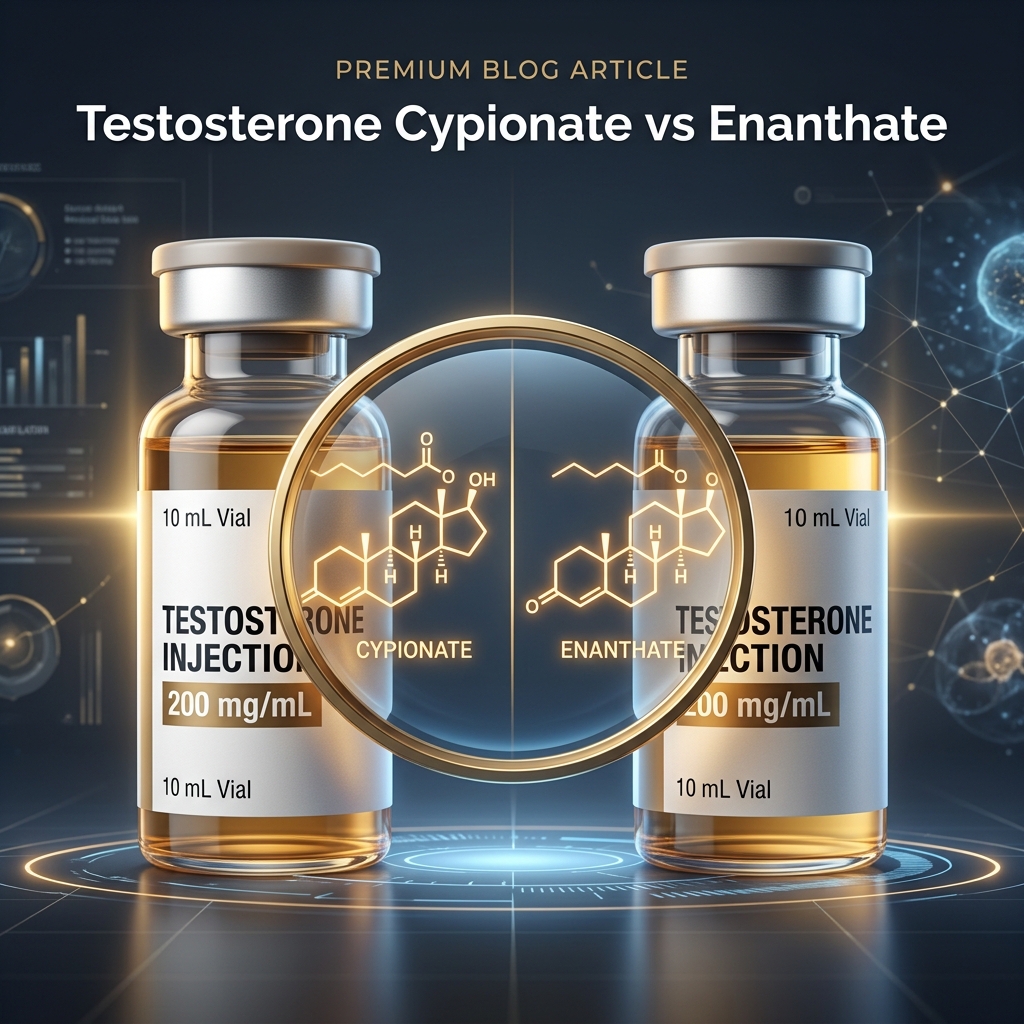
The short answer: for clinical purposes, the difference is negligible. Testosterone cypionate and testosterone enanthate are the two most commonly prescribed injectable testosterone esters, and they are functionally interchangeable. The difference between them is a single carbon atom in the ester chain, which translates to a half-life difference of roughly 1 day. In practice, most men won't notice any difference when switching between the two.
That said, there are practical differences in availability, cost, and carrier oil that are worth understanding — especially if you're choosing a TRT provider. Telehealth FX prescribes testosterone cypionate, the US standard, at $79/month.
Chemical and Pharmacokinetic Differences
| Property | Cypionate | Enanthate |
|---|---|---|
| Ester chain | 8-carbon cyclopentylpropionate | 7-carbon heptanoic acid |
| Half-life | ~8 days | ~7 days |
| Injection frequency | 1–2x/week | 1–2x/week |
| Carrier oil | Cottonseed oil (typically) | Sesame oil (typically) |
| US availability | Widely available (dominant in US) | Available but less common |
| Cost (generic 10mL) | $30–80 | $40–100 |
Why Cypionate Dominates in the US
Testosterone cypionate is the standard in the United States primarily for historical and regulatory reasons — it was the first ester to receive widespread US FDA approval, and the supply chain is deeply established. Enanthate is more common in Europe and other international markets. Both are Schedule III controlled substances in the US.
From a clinical perspective, the AUA and Endocrine Society guidelines make no distinction between the two — both are listed as first-line injectable options with identical dosing recommendations.
Carrier Oil Matters More Than You Think
The carrier oil is the most practically relevant difference. Cottonseed oil (cypionate) and sesame oil (enanthate) have different viscosities and allergen profiles. If you have a cottonseed or sesame allergy, this determines which ester you can use. Some compounding pharmacies offer both esters in alternative carrier oils (MCT oil, grape seed oil) — ask your provider if you have sensitivities.
MCT oil-based formulations tend to inject more smoothly through smaller gauge needles, which is relevant for subcutaneous injection protocols. See our dosage and injection guide for needle selection tips.
Testosterone Cypionate From $79/mo
The US gold standard. Medication, clinician oversight, and free shipping included.
Check Your EligibilityCan You Switch Between Esters?
Yes — seamlessly. The conversion is 1:1 (100mg cypionate ≈ 100mg enanthate). The slightly shorter half-life of enanthate means a marginally faster washout, but for practical purposes you can switch on the same day with no protocol changes. If you're switching providers and one uses a different ester, there's no concern.
Frequently Asked Questions
Is one ester "stronger" than the other?
No. Both deliver the same active molecule (testosterone) after the ester is cleaved by esterases. The same dose produces virtually identical serum testosterone levels.
Why do some bodybuilders prefer enanthate?
Mostly availability — enanthate is more common in international markets. At TRT doses (100–200mg/week), there is no clinical difference. This article is about therapeutic TRT, not performance-enhancing use.
What about testosterone propionate or undecanoate?
Propionate has a very short half-life (~2 days) requiring every-other-day injections — rarely used for TRT. Undecanoate (Aveed) has an ultra-long half-life (~34 days) administered every 10 weeks in-office. Both are niche options. Compare all delivery methods.
Start TRT. From $79/mo.
Testosterone Cypionate. Licensed clinicians. Free shipping. See all plans.
Start Your EvaluationReferences
- Bhasin, S., et al. (2018). Testosterone therapy guidelines. JCEM, 103(5), 1715–1744. academic.oup.com
- Nieschlag, E. (2006). Testosterone treatment comes of age. Clin Endocrinol, 65(3), 275–281. pubmed.ncbi.nlm.nih.gov
- FDA. (2024). Approved drug products — Testosterone Cypionate and Enanthate monographs. accessdata.fda.gov
- Edelstein, D., et al. (2007). Pharmacokinetics of injectable testosterone preparations. Eur J Endocrinol, 157(5), 593–598. pubmed.ncbi.nlm.nih.gov