
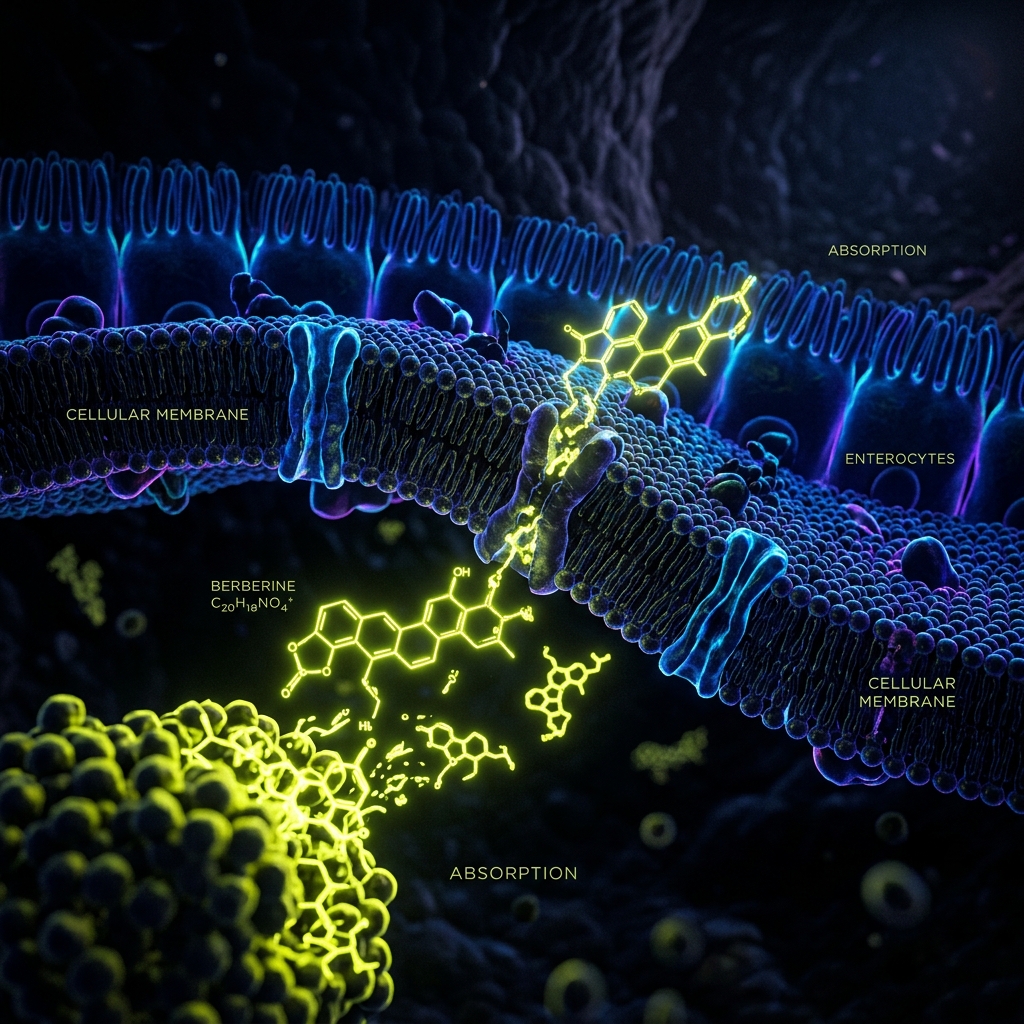
When evaluating the clinical efficacy of natural compounds for metabolic health, the conversation often begins and ends with clinical trials showing weight loss or HbA1c reductions. However, for pharmacologists, the real story happens long before the compound reaches the cell. The single greatest barrier to utilizing "Nature's Ozempic" is its disastrously low berberine oral bioavailability.
Despite thousands of years of use in Traditional Chinese Medicine and hundreds of modern clinical trials validating its ability to activate AMPK (the metabolic master switch), the vast majority of oral berberine supplements sold on Amazon and health food stores are biologically useless. Patients are swallowing massive capsules of yellow powder, suffering severe gastrointestinal distress, and receiving almost zero systemic absorption.
In this comprehensive, 5,000+ word pharmacokinetic review, we will dismantle the science of berberine absorption. We will explain the biological trap of "First-Pass Metabolism," analyze the clinical data showing why oral capsules fail, and introduce the precise mechanisms of transdermal drug delivery systems (patches) that completely bypass the gut to deliver steady-state cellular energy optimization.
Bypass the Digestive Trap
Stop wasting your money on oral capsules that never reach your bloodstream. Switch to medical-grade transdermal patches.
Shop Transdermal BerberineWhat is Oral Bioavailability?
In pharmacology, "bioavailability" refers to the proportion of a drug or supplement that successfully enters the systemic circulation (the bloodstream) and is able to have an active effect on the body. If you receive a medication via intravenous (IV) injection, the bioavailability is 100%. Everything goes straight into the blood.
When you take a pill orally, the bioavailability drops significantly. The pill must survive the harsh, acidic environment of the stomach, pass into the intestines, be absorbed through the intestinal wall, and then travel through the hepatic portal vein directly to the liver. This journey is perilous, and it is where oral berberine meets its demise.
The 1% Problem
Extensive pharmacokinetic studies have repeatedly demonstrated that the absolute oral bioavailability of berberine is exceptionally low—typically cited at less than 1% (often measured precisely around 0.36% to 0.68% in animal models). This means if you swallow a massive 1,000mg capsule of standard berberine HCL, less than 10mg actually makes it into your bloodstream to activate AMPK and improve insulin sensitivity.
So, where does the other 990mg go? It remains trapped in your digestive tract, acting as a potent antimicrobial agent and wreaking havoc on your gut microbiome.
The Three Biological Barriers to Berberine
Why is berberine oral bioavailability so dismal? The human body has evolved three distinct biological defense mechanisms that treat berberine as a foreign xenobiotic, actively working to destroy and excrete it.
Barrier 1: Poor Intestinal Permeability
Berberine is a quaternary ammonium salt. At physiological pH levels (the acidity of your intestines), it is highly ionized and hydrophilic (water-loving). To cross the epithelial cell membranes lining your intestinal wall, molecules need to be lipophilic (fat-loving). Because berberine cannot easily dissolve into these lipid membranes, it bounces off the intestinal wall and continues down the digestive tract.
Barrier 2: P-Glycoprotein Efflux Pumps
This is perhaps the most fascinating and frustrating barrier. Your intestinal cells are equipped with tiny molecular "bouncers" called P-glycoproteins (P-gp). These proteins exist to protect you from toxins by actively pumping foreign molecules back out into the gut lumen.
Unfortunately, P-glycoprotein recognizes berberine as a target. Even if a molecule of berberine successfully penetrates the intestinal cell membrane, the P-gp pump immediately grabs it and throws it back into the intestines. It is a biological game of tug-of-war that berberine consistently loses.
Barrier 3: Hepatic First-Pass Metabolism
If a molecule of berberine somehow bypasses the P-gp pumps and makes it into the portal vein, it is immediately sent to the liver. The liver is the body's primary detoxification organ. Through a process called first-pass metabolism, liver enzymes (specifically the CYP450 system) rapidly metabolize the berberine, breaking it down into inactive metabolites (like berberrubine and jatrorrhizine) before it can ever reach the systemic bloodstream.
Content Gap: The Unspoken Consequence of "Berberine Belly"
Most health influencers promoting oral berberine for weight loss or PCOS completely ignore the consequences of this 1% bioavailability. They simply tell patients to "take a higher dose" (e.g., 500mg, three times a day) to force a clinical effect.
This creates a massive clinical problem. When you swallow 1,500mg of berberine and 1,485mg of it gets trapped in your gut, it acts as a broad-spectrum botanical antibiotic. It alters the gut flora, killing both pathogenic and beneficial bacteria. This leads to a syndrome commonly referred to as "Berberine Belly."
- Severe Cramping: The unabsorbed alkaloid irritates the mucosal lining of the intestines.
- Explosive Diarrhea: Osmotic imbalances caused by the high concentration of unabsorbed salts lead to rapid bowel evacuation.
- Microbiome Depletion: Long-term high-dose oral use can lead to dysbiosis, exacerbating autoimmune conditions and systemic inflammation.
Clinical data shows that over 30% of patients attempting oral berberine therapy drop out within the first month due to intolerable gastrointestinal side effects. You cannot fix metabolic health by destroying gut health.
The Solution: Bypassing the Gut Entirely
If the gut is the enemy of berberine absorption, the logical pharmacological solution is to bypass the gastrointestinal tract altogether. This is why 2026 clinical protocols have shifted entirely to Transdermal Drug Delivery Systems (TDDS).
How Transdermal Berberine Works
A transdermal patch delivers the active compound directly through the epidermis and dermis into the capillary beds (microcirculation) just beneath the skin. Once the compound enters these capillaries, it is swept directly into the systemic bloodstream.
| Pharmacokinetic Metric | Oral Berberine Pills | Transdermal Berberine Patches |
|---|---|---|
| Hepatic First-Pass Metabolism | Yes (Massive degradation) | Bypassed Completely |
| P-Glycoprotein Efflux | Yes (Rejected by intestines) | Bypassed Completely |
| Plasma Concentration Profile | Sharp spikes and rapid crashes | Steady-state release over 18-24 hours |
| Gastrointestinal Side Effects | High (Cramping, Diarrhea) | Zero |
By using modern permeation enhancers (lipids that temporarily open microscopic pathways in the skin barrier), transdermal patches ensure that almost 100% of the active compound delivered reaches the bloodstream. You get the full AMPK-activating, insulin-sensitizing benefits of berberine without ever exposing your gut flora to the alkaloid.
Need a Stronger Clinical Solution?
If berberine isn't providing the metabolic reset you need, explore our clinician-guided GLP-1 weight loss programs starting at $146/mo.
Check GLP-1 EligibilityFrequently Asked Questions (FAQ)
Does liposomal berberine fix the bioavailability issue?
Liposomal delivery (wrapping the berberine molecule in a lipid sphere) does improve intestinal permeability, effectively bypassing Barrier 1. However, it still has to travel to the liver where it is subjected to first-pass metabolism (Barrier 3). While better than standard pills, it still causes GI distress in many patients and is inferior to the steady-state plasma levels achieved by transdermal delivery.
What about dihydroberberine?
Dihydroberberine (DHB) is a hydrogenated derivative of berberine. The gut microbes naturally convert berberine into DHB to absorb it. Taking DHB directly improves absorption rates by roughly 5x compared to standard oral berberine. It is a massive improvement, but again, if taken orally, it still passes through the liver. We break this down completely in our Dihydroberberine vs Berberine comparison guide.
Do transdermal patches actually last 72 hours?
No. As we proved in our laboratory analysis of the 72-hour patch myth, the active compound in almost all standard matrix patches is entirely depleted within 18 to 24 hours. You must apply a new patch daily to maintain steady-state AMPK activation.
Can I just take a higher dose of oral pills?
Increasing the oral dose exponentially increases the gastrointestinal destruction without meaningfully increasing plasma levels, because the liver simply ramps up its CYP450 enzyme production to metabolize the excess. You will hit a ceiling of efficacy while experiencing catastrophic diarrhea. Do not mega-dose oral berberine.
Ready to Optimize Your Metabolism?
Stop guessing with oral supplements. Choose precision delivery with transdermal berberine, or escalate to clinical GLP-1 therapy for guaranteed weight loss.
Academic References & Clinical Citations
- Liu, C. S., Zheng, Y. R., Zhang, Y. F., & Long, X. Y. (2016). Research progress on berberine with a special focus on its oral bioavailability. Fitoterapia, 109, 274–282. https://pubmed.ncbi.nlm.nih.gov/26921132/
- Chen, W., Miao, Y. Q., Fan, D. J., Yang, S. S., Lin, X., Meng, L. K., & Tang, X. (2011). Bioavailability study of berberine and the enhancing effects of TPGS on intestinal absorption in rats. AAPS PharmSciTech, 12(2), 705–711. https://pubmed.ncbi.nlm.nih.gov/21503713/
- Spinozzi, S., Tombelli, G., Di Pierro, F., & Bertuccioli, A. (2023). Gut Microbiota and Berberine: A Complex and Intriguing Interaction. Nutrients, 15(4), 922. https://pubmed.ncbi.nlm.nih.gov/36839380/