
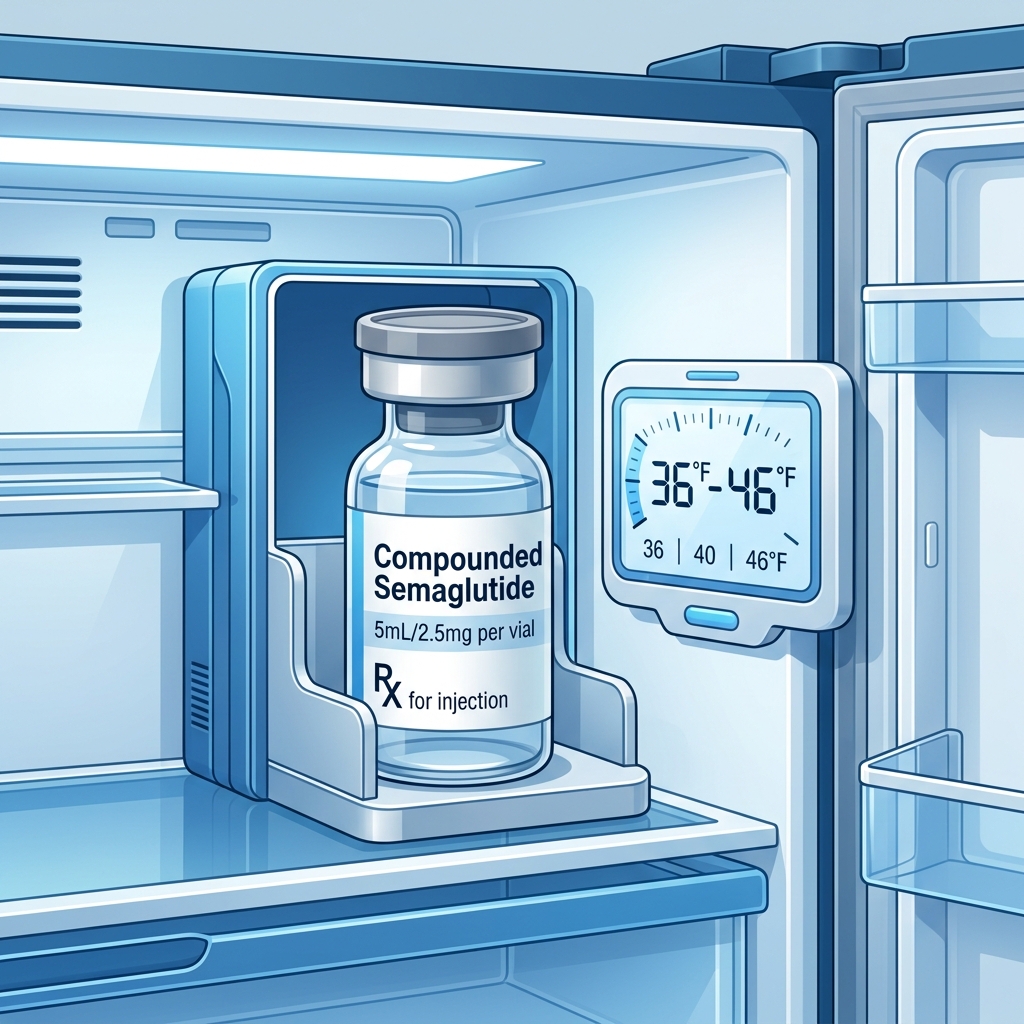
Compounded semaglutide is a peptide — a fragile chain of amino acids that degrades when exposed to heat, freezing, direct sunlight, or contamination. Improper storage does not just reduce efficacy — it can render your medication completely useless, wasting $199+ and disrupting your weight loss timeline. This guide covers everything: home storage, travel storage, signs of degradation, and the mistakes that destroy medication.
Unlike brand-name Ozempic or Wegovy (which come in manufacturer pens with built-in stability data), compounded semaglutide arrives in multi-dose vials from 503A or 503B pharmacies. Storage requirements are similar but not identical to brand medications, and the beyond-use dates (BUDs) assigned by compounding pharmacies vary significantly. Understanding these nuances protects your investment and your results.
Storage Requirements: The Rules
| Condition | Unopened Vial | Opened/In-Use Vial | Notes |
|---|---|---|---|
| Temperature | 36–46°F (2–8°C) | 36–46°F (2–8°C) | Keep refrigerated at all times |
| Room temp tolerance | Avoid | Brief exposure OK (1–2 hours) | Unlike brand pens, compounded has shorter stability |
| Light | Protect from light | Protect from light | Store in original box or wrap in foil |
| Freezing | NEVER freeze | NEVER freeze | Ice crystals destroy peptide structure permanently |
| Beyond-use date | Per pharmacy label | 28 days typical (check label) | Discard after BUD regardless of remaining volume |
Critical distinction from brand medications: Brand Ozempic pens can be stored at room temperature (up to 86°F) for 56 days once in use. Compounded semaglutide in vials does NOT have the same room-temperature stability because compounding pharmacies use different formulations and preservative systems. Always keep compounded semaglutide refrigerated unless actively drawing a dose.
Refrigerator Placement: Where in the Fridge Matters
Not all areas of your refrigerator maintain the same temperature. Improper placement is the #1 cause of accidental freezing (which permanently destroys the medication):
- Best location: Middle shelf, center of refrigerator. This is the most temperature-stable zone.
- Avoid the back wall: The cooling element is located behind the back wall. Vials placed directly against the back wall can freeze — even if the fridge thermostat reads 38°F.
- Avoid the door: Door compartments experience the most temperature fluctuation (up to 10°F variation with each opening). Never store medication in the door.
- Avoid the vegetable drawer: Often too cold and too humid.
- Keep in a small container: Place the vial in a small, lidded container (like a butter dish) to buffer against temperature swings and protect from accidental contact with frozen items.
Signs Your Medication Has Gone Bad
Inspect your vial before every injection. Degraded semaglutide may be ineffective or unsafe:
- Cloudiness or particles: Semaglutide solution should be clear and colorless. Any cloudiness, floating particles, or precipitate indicates protein aggregation — do NOT use.
- Color change: Any yellowing, browning, or coloration indicates oxidative degradation. Discard immediately.
- Unusual smell: Semaglutide should be odorless. Any off-smell suggests bacterial contamination.
- Ice crystals in the vial: Even partial freezing permanently denatures the peptide. If you see any ice formation — even if the liquid has since thawed — the medication is destroyed.
- Reduced efficacy: If you notice your appetite suppression weakening significantly without a dose change, check your storage conditions. Degraded medication will still inject normally but will not work.
Quality-Assured Compounded Medication. Shipped Cold.
TelehealthFX ships compounded semaglutide in insulated, cold-chain packaging. From $199/month. HSA/FSA accepted.
Start Your EvaluationTravel Storage
Traveling with compounded semaglutide requires more care than brand pens because of the shorter room-temperature tolerance. See our complete GLP-1 travel guide for detailed TSA rules and international travel guidance. Key points for compounded medication specifically:
- Always use an insulated medication travel case with gel ice packs (FRIO, 4AllFamily, or similar).
- Never put in checked luggage — cargo holds can reach freezing temperatures.
- Request a hotel mini-fridge — set to the lowest non-freezing setting (typically 36–40°F). Place a thermometer inside to verify.
- For road trips: Use a cooler with ice packs, but place the vial inside a zip-lock bag wrapped in a washcloth to prevent direct contact with ice (which causes freezing).
Injection Preparation: Sterile Technique
Compounded semaglutide in multi-dose vials requires proper technique to prevent contamination:
- Wash hands thoroughly with soap and water before handling the vial.
- Clean the vial stopper with a fresh alcohol swab. Let it dry completely (30 seconds) before inserting the needle.
- Use a new syringe and needle for every injection — never reuse syringes, even from the same vial.
- Draw the dose with the vial inverted (upside down) to avoid drawing air bubbles.
- Inject into a clean site (abdomen, thigh, or upper arm) cleaned with alcohol. Rotate injection sites to prevent lipodystrophy.
- Dispose of needles in an FDA-cleared sharps container. Never recap used needles.
For complete injection technique and optimal timing, see our injection guide. If you are switching from a brand pen to compounded, see our provider switching guide for transition best practices.
Frequently Asked Questions
How long does compounded semaglutide last once opened?
Typically 28 days from first puncture, but this varies by pharmacy. Always check the beyond-use date on your specific vial label. Some 503B pharmacies assign longer BUDs based on stability testing. Discard any remaining medication after the BUD — even if the vial is not empty.
What if my medication was left out of the fridge overnight?
A single overnight exposure at room temperature (68–72°F) for 8–12 hours is unlikely to cause significant degradation. Refrigerate immediately and monitor for cloudiness. If the room was hot (80°F+), contact your pharmacy for guidance. Repeated room-temperature exposure is more damaging than a single incident.
Is compounded semaglutide as stable as brand Ozempic?
Brand Ozempic pens contain proprietary stabilizers and have undergone extensive stability testing (56 days at room temperature). Compounded formulations use different excipients and typically have shorter stability profiles. This is why refrigeration is more important for compounded medication. The efficacy when properly stored is equivalent — see our safety analysis.
Can I fly with compounded semaglutide syringes?
Yes. TSA permits syringes when accompanied by injectable medication. Carry the vial in its original labeled packaging. See our travel guide for the complete checklist.
Cold-Chain Shipped. Quality Assured. From $199/mo.
Compounded semaglutide from FDA-registered pharmacies. HSA/FSA accepted.
Get StartedReferences
- USP 797. (2023). Pharmaceutical Compounding — Sterile Preparations. United States Pharmacopeia.
- Novo Nordisk. (2024). Ozempic prescribing information — storage and handling. FDA Label.
- FDA. (2024). Compounding and the FDA: Questions and Answers. FDA Guidance.