
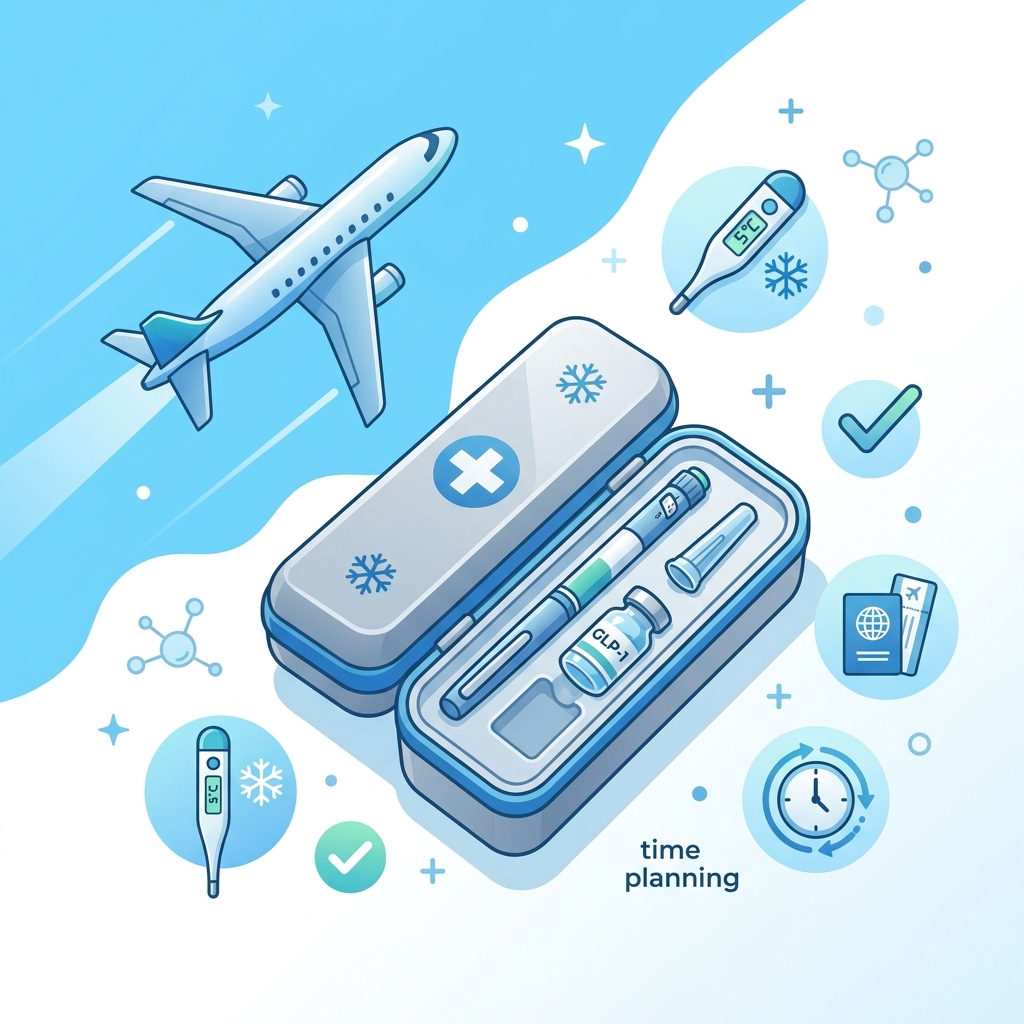
Traveling while on semaglutide or tirzepatide raises practical questions that most clinicians never address: Can you bring an injection pen through airport security? How do you keep medication cold during a 14-hour flight? What happens if your injection day falls mid-travel? This guide covers every scenario — from TSA rules to international travel, from cruise ships to camping trips.
The stakes are real: semaglutide and tirzepatide are peptide medications that degrade when exposed to heat, freezing, or prolonged light exposure. Improper storage during travel can render your medication ineffective — a $200–$400 mistake that also disrupts your weight loss timeline. Prevention is straightforward with the right preparation.
TSA and Airport Security: The Rules
Injectable medications are explicitly exempt from the TSA 3-1-1 liquids rule. You may bring your GLP-1 pen, vials, and syringes in your carry-on bag in any quantity. You do not need a separate plastic bag. However, you should follow these best practices to avoid delays at security checkpoints:
- Carry a copy of your prescription or pharmacy label with your name on it. While TSA does not legally require it, it prevents questions and delays.
- Declare your medication at the security checkpoint. Tell the TSA agent: "I have injectable medication in my bag." This prevents them from flagging it during the X-ray scan.
- Keep medication in original packaging when possible — the pharmacy label serves as proof of prescription.
- Syringes must accompany injectable medication. Carrying syringes without a corresponding medication may raise questions.
- Ice packs and cooling cases are allowed in carry-on bags for medication storage. They can be frozen, liquid, or gel — all are permitted when accompanying medication.
For compounded semaglutide (which comes in multi-dose vials rather than manufacturer pens), the same rules apply. The vial, syringes, and alcohol swabs are all permitted in carry-on luggage.
Temperature and Storage During Travel
| Medication | Refrigerated (Unopened) | Room Temp (Opened/In-Use) | Max Temp Tolerance | Freeze Tolerance |
|---|---|---|---|---|
| Semaglutide (Ozempic/Wegovy) | 36–46°F (2–8°C) | Up to 56 days at 59–86°F | 86°F (30°C) | Do NOT freeze |
| Tirzepatide (Mounjaro/Zepbound) | 36–46°F (2–8°C) | Up to 21 days at 77°F | 86°F (30°C) | Do NOT freeze |
| Compounded semaglutide | 36–46°F (2–8°C) | Varies — check pharmacy label | Check label | Do NOT freeze |
Critical rule: Never put GLP-1 medication in checked luggage. Cargo holds can reach temperatures below freezing during flight, which permanently destroys the peptide structure. Always carry medication in your personal carry-on bag. See our detailed storage guide for home and travel storage protocols.
Essential Travel Kit Checklist
- Insulated medication travel case (brands: FRIO, MedAngel, 4AllFamily) — maintains temperature for 24–48 hours without electricity
- Gel ice packs (2–3, pre-frozen) — wrap in a washcloth to prevent direct contact with medication
- Digital thermometer — check case temperature periodically during long travel days
- Prescription copy or pharmacy label — for TSA and international customs
- Alcohol swabs and syringes (for compounded medication) — carry extras in case of loss
- Sharps container (travel-size) — required for used needles. Small travel containers are available at any pharmacy.
International Travel Considerations
Traveling internationally with injectable medication requires additional preparation. Most countries permit travelers to bring personal-use medication, but regulations vary significantly:
- Carry a doctor's letter on letterhead stating: your name, the medication name, the medical necessity, and that it must be injected (this prevents customs from confiscating needles).
- Research destination country regulations — some countries (Japan, UAE, Singapore) have strict controlled substance laws. GLP-1 agonists are not controlled substances, but customs officers may not know this.
- Time zone adjustments: If your injection day shifts by 12+ hours due to time zone changes, you can safely adjust by 1–2 days. Semaglutide has a 7-day half-life — shifting your injection day by 24–48 hours will not affect efficacy. Resume your normal schedule upon return.
- Bring enough medication for the entire trip plus 1 extra week — do not plan to refill abroad. GLP-1 shortages affect many countries, and compounded medication is not available internationally.
Plan Ahead — Get Extra Medication Before Your Trip
TelehealthFX ships medication nationwide. Request an early refill before travel. From $199/month. HSA/FSA accepted.
Start Your EvaluationMaintaining Nutrition and Exercise While Traveling
Travel disrupts two pillars of your GLP-1 protocol: nutrition and exercise. The good news: GLP-1 naturally suppresses appetite during travel, making it easier to avoid airport junk food. The challenge is maintaining protein intake when restaurant options are limited.
Pack portable protein: protein bars (30g+ protein per bar), single-serve whey packets, beef jerky, and mixed nuts. These ensure you hit your protein target even during long travel days when full meals are not available. Stay hydrated aggressively — air travel is profoundly dehydrating, which compounds GLP-1's effects on constipation.
For exercise: hotel gyms, bodyweight circuits, walking tours, and swimming all maintain your routine. Even 20 minutes of activity per day preserves your NEAT levels and prevents the metabolic slowdown that triggers plateaus.
Frequently Asked Questions
Can I inject on the airplane?
Yes. There is no rule against injecting medication on an aircraft. Choose the lavatory for privacy and hygiene. Dispose of needles in your travel sharps container — never in the airplane trash.
What if my medication gets warm during travel?
In-use semaglutide pens can tolerate up to 86°F (30°C) for up to 56 days. Brief exposure above this threshold (a few hours in a hot car) may not destroy the medication, but repeated or prolonged heat exposure reduces potency. If your medication was exposed to extreme heat (100°F+ for several hours), contact your pharmacy for guidance.
Can I shift my injection day for travel?
Yes. Semaglutide and tirzepatide have long half-lives. You can safely shift your injection day by 1–2 days in either direction. If your normal injection day is Wednesday but you are on an international flight, injecting on Tuesday or Thursday is perfectly acceptable. See our injection timing guide for detailed scheduling advice.
Ship Medication Before Your Trip. From $199/mo.
Nationwide shipping. Early refills available. Same-day evaluations.
Get StartedReferences
- TSA. (2026). Disabilities and Medical Conditions — Medication. Transportation Security Administration.
- Novo Nordisk. (2024). Ozempic prescribing information — storage and handling. FDA Label.
- Eli Lilly. (2024). Mounjaro prescribing information — storage and handling. FDA Label.