
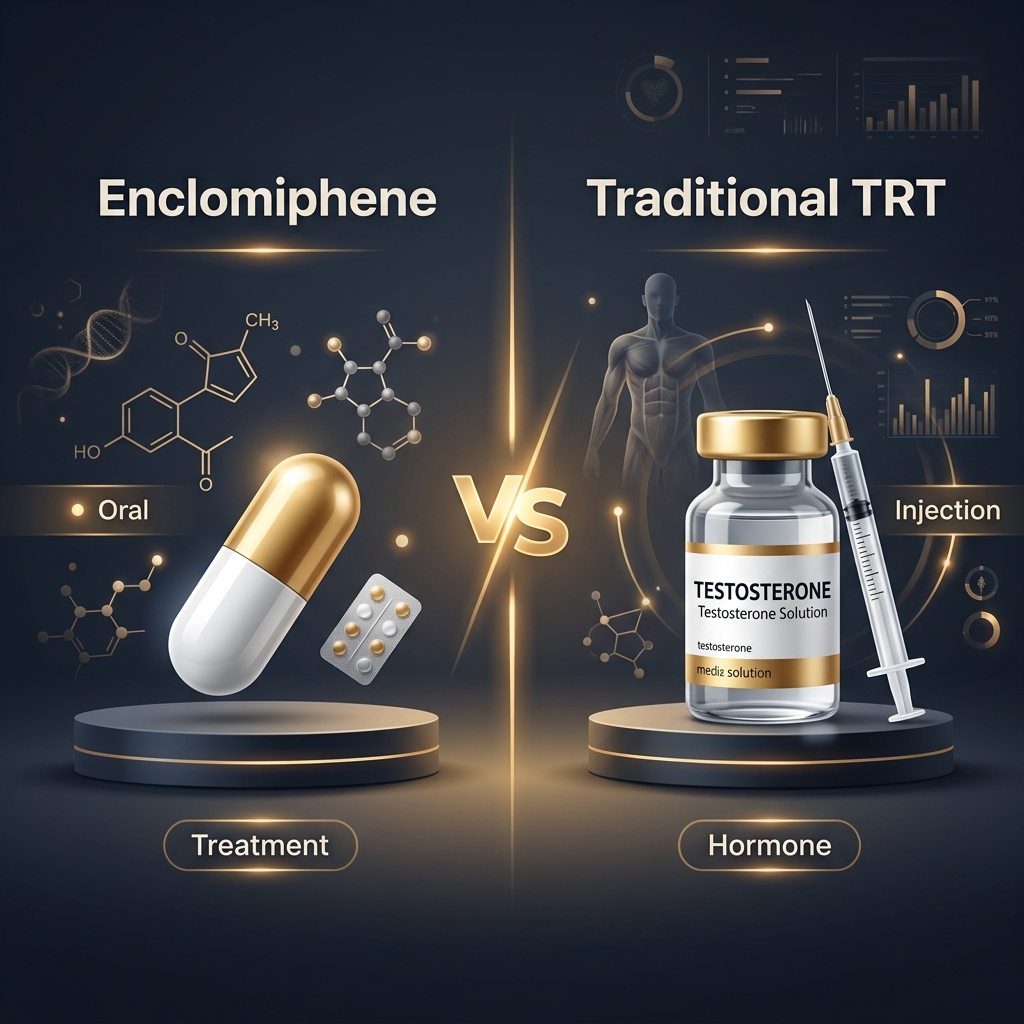
For men who want higher testosterone but aren't ready to accept the fertility trade-off of traditional TRT, enclomiphene citrate has emerged as the most compelling alternative. Unlike exogenous testosterone (which shuts down your body's natural production), enclomiphene stimulates your pituitary gland to produce more LH and FSH — your body makes its own testosterone while maintaining sperm production.
This distinction matters enormously for men under 40 who plan to have children, or anyone who wants to avoid the "once you start, you can't stop" dynamic of traditional TRT. Telehealth FX offers both Enclomiphene and traditional TRT — your clinician recommends the best option based on your age, fertility plans, and lab results.
How Each Works: Replacing vs Stimulating
| Factor | Enclomiphene | Traditional TRT |
|---|---|---|
| Mechanism | Blocks estrogen at pituitary → ↑ LH/FSH → ↑ natural T | Exogenous testosterone replacement |
| T increase | +150–250 ng/dL (moderate) | Targets 600–1,100 ng/dL (controllable) |
| Fertility | Preserved — LH/FSH maintained | Suppressed — spermatogenesis stops |
| Testicular size | Maintained | Atrophy without HCG co-therapy |
| Delivery | Oral pill (daily) | Injection, cream, or pellet |
| Stopping therapy | Natural production resumes quickly | Recovery can take months (PCT needed) |
| Cost | $79–150/mo | $79–300/mo |
Clinical Efficacy: What the Data Shows
In clinical studies, enclomiphene citrate 25mg daily increased total testosterone by an average of 150–250 ng/dL over 12–16 weeks. For a man starting at 280 ng/dL, this could push levels to 430–530 ng/dL — clinically meaningful, but typically not reaching the 700–900+ ng/dL levels achievable with injectable testosterone.
For men with secondary hypogonadism (functioning testes, but underperforming pituitary signaling), enclomiphene can be highly effective. For men with primary hypogonadism (damaged testes), it's less effective because the testes can't respond adequately to increased LH signaling. Your labs reveal which category you fall into.
The Ideal Enclomiphene Candidate
- Age 25–40 with plans to have children in the next 1–5 years
- Mild-to-moderate hypogonadism (total T 250–400 ng/dL) with intact testicular function
- Men who want to try hormone optimization without committing to lifelong exogenous testosterone
- Needle-averse patients — enclomiphene is a daily oral tablet
- Men transitioning off TRT who want to restart natural production
Enclomiphene or TRT? Your Clinician Decides.
Both available through Telehealth FX. From $79/mo. Your labs and fertility goals determine the recommendation.
Check Your EligibilityCan You Switch from TRT to Enclomiphene?
Yes — and this is one of enclomiphene's most valuable applications. Men who want to come off exogenous testosterone (for fertility or other reasons) can use enclomiphene as a bridge to restart natural production. The typical protocol:
- Taper testosterone dose over 2–4 weeks
- Begin enclomiphene 25–50mg daily as testosterone is discontinued
- Monitor LH, FSH, and total T at 4, 8, and 12 weeks
- Adjust dose based on response — some men maintain on 12.5mg daily long-term
This is a far smoother transition than cold-turkey TRT cessation, which can cause weeks of fatigue, depression, and sexual dysfunction. Also see our HCG protocol guide for an alternative bridging approach.
Side Effects Comparison
Enclomiphene side effects are generally milder than TRT: occasional headaches, mild visual disturbances (rare, dose-dependent), and mood changes. It does not cause erythrocytosis (elevated hematocrit), testicular atrophy, or fertility suppression. However, because it increases LH/FSH, estradiol may rise — requiring monitoring but rarely needing an aromatase inhibitor.
For a comprehensive look at TRT-specific risks, see our complete side effects guide.
Frequently Asked Questions
Is enclomiphene FDA-approved?
Enclomiphene citrate is not currently FDA-approved as a standalone drug for hypogonadism (its New Drug Application was withdrawn for commercial reasons, not safety). It is prescribed off-label or compounded by licensed pharmacies. This is standard medical practice for many hormone medications.
Can I take enclomiphene and TRT together?
Generally not simultaneously — they have opposing mechanisms. Enclomiphene stimulates LH/FSH, while exogenous testosterone suppresses it. However, sequential use (TRT → enclomiphene transition) is a proven protocol.
How long does enclomiphene take to work?
Most men see testosterone levels rise within 2–4 weeks. Symptom improvement follows: energy and mood improve first (2–3 weeks), libido and sexual function follow (4–8 weeks), and body composition changes emerge over 8–12 weeks.
Boost T Without Sacrificing Fertility. From $79/mo.
Enclomiphene and TRT both available. Your clinician recommends. See all plans.
Start Your EvaluationReferences
- Kim, E. D., et al. (2016). Enclomiphene citrate raises testosterone while preserving sperm counts. BJU Int, 117(4), 677–685. pubmed.ncbi.nlm.nih.gov
- Wiehle, R. D., et al. (2014). Enclomiphene citrate in secondary hypogonadism. Fertil Steril, 101(3), 849–854. pubmed.ncbi.nlm.nih.gov
- Bhasin, S., et al. (2018). Testosterone therapy guidelines. JCEM, 103(5), 1715–1744. academic.oup.com
- AUA. (2021). Male infertility best practice policy — hormonal therapy considerations. auanet.org