
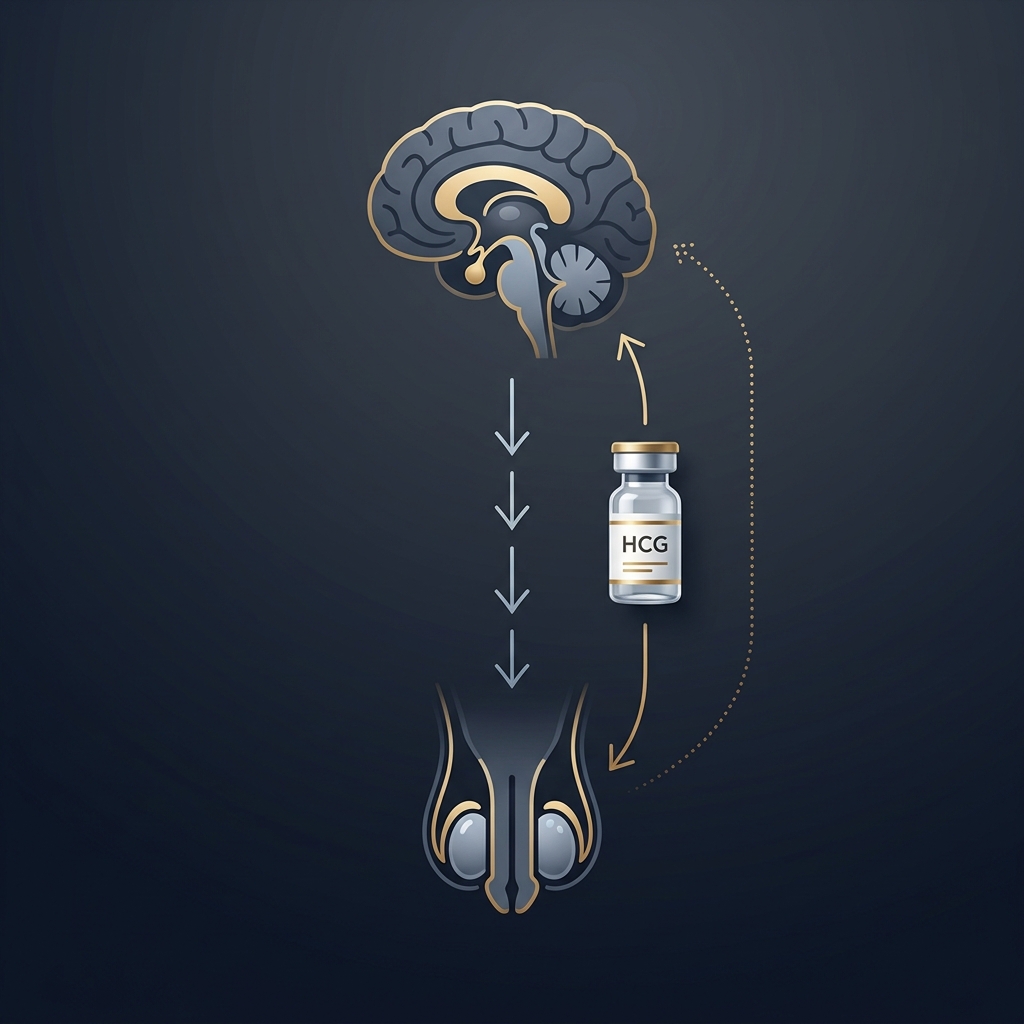
Human Chorionic Gonadotropin (HCG) is the most commonly prescribed adjunctive medication alongside testosterone replacement therapy. Its primary role: preventing testicular atrophy and maintaining fertility while on exogenous testosterone. Without HCG (or Enclomiphene), the testes stop producing testosterone and sperm within 4–8 weeks of starting TRT — leading to noticeable shrinkage and azoospermia.
But HCG isn't right for everyone. This article explains who needs it, who doesn't, how to dose it, the regulatory challenges since 2020, and the Enclomiphene alternative. Telehealth FX clinicians include HCG or Enclomiphene when clinically indicated as part of your all-inclusive TRT protocol.
What HCG Does in a TRT Protocol
HCG mimics Luteinizing Hormone (LH) — the pituitary hormone that signals the testes to produce testosterone. When you take exogenous testosterone, your pituitary stops producing LH (negative feedback), and your testes shut down. HCG restores that signal artificially:
- Prevents testicular atrophy: Maintaining intratesticular testosterone keeps Leydig cells active and testes at normal size.
- Preserves spermatogenesis: Unlike exogenous testosterone, HCG maintains sufficient intratesticular testosterone to support sperm production.
- Supports pregnenolone/DHEA: The intratesticular steroidogenic pathway produces neurosteroids that pure exogenous T doesn't replace — some men report mood improvements with HCG for this reason.
HCG Dosing Protocols
| Goal | Typical Dose | Frequency | Notes |
|---|---|---|---|
| Testicular maintenance | 250–500 IU | 2–3x/week | Standard alongside TRT |
| Fertility preservation | 500–1,000 IU | 3x/week | Higher dose; monitor E2 closely |
| Fertility restart (post-TRT) | 1,000–2,000 IU | 3x/week for 6–12 weeks | Combined with FSH if needed |
Who Needs HCG?
- Men planning children within the next 1–5 years — non-negotiable for fertility preservation on TRT
- Men who notice testicular atrophy on TRT — HCG reverses this within 4–8 weeks
- Men who feel "flat" on TRT despite good testosterone levels — the neurosteroid pathway may be the issue
Who Doesn't Need HCG?
- Men with completed families who have no fertility concerns
- Men who feel great on TRT alone with no testicular complaints
- Men who prefer to minimize injection burden (HCG adds 2–3 additional injections per week)
Complete TRT Protocols Including HCG
Your clinician determines if HCG or Enclomiphene should be part of your protocol. From $79/mo.
Check Your EligibilityHCG vs Enclomiphene: The Modern Alternative
Since 2020, compounding pharmacy access to HCG has been complicated by regulatory changes (HCG was reclassified as a biologic under the BPCIA). This has increased costs and reduced availability at some pharmacies. Enclomiphene citrate has emerged as a practical oral alternative:
- HCG: Injectable, mimics LH directly, proven fertility preservation, requires refrigeration
- Enclomiphene: Oral tablet, stimulates your own LH production, no refrigeration, simpler logistics
Both work for fertility preservation and testicular maintenance. Enclomiphene is increasingly the preferred option due to convenience and regulatory simplicity. Your clinician will recommend the best fit based on your overall protocol.
Frequently Asked Questions
Does HCG increase estrogen?
Yes — HCG stimulates intratesticular testosterone production, which can aromatize to estradiol. This is why estradiol should be monitored when HCG is added. If E2 rises above 50 pg/mL with symptoms, a low-dose aromatase inhibitor may be warranted.
Can I start HCG after being on TRT for years?
Yes, though the response may be slower if the testes have been suppressed for an extended period. Most men see testicular size improvement within 4–8 weeks and fertility restoration within 3–6 months.
Is HCG included in the $79/mo TRT plan?
Ancillary medications like HCG or Enclomiphene may be included or available as add-ons depending on your plan. Check pricing details or ask during your intake.
Complete Hormone Optimization. From $79/mo.
TRT + HCG + Enclomiphene — whatever your protocol needs. See all plans.
Start Your EvaluationReferences
- Hsieh, T. C., et al. (2013). Concomitant intramuscular HCG preserves spermatogenesis in men on TRT. J Urol, 189(2), 647–650. pubmed.ncbi.nlm.nih.gov
- FDA. (2020). Biologics Price Competition and Innovation Act — HCG reclassification. fda.gov
- Coviello, A. D., et al. (2005). Low-dose HCG maintains intratesticular testosterone. JCEM, 90(9), 5105–5109. pubmed.ncbi.nlm.nih.gov
- AUA. (2021). Male infertility best practice policy — adjunctive therapy during TRT. auanet.org