
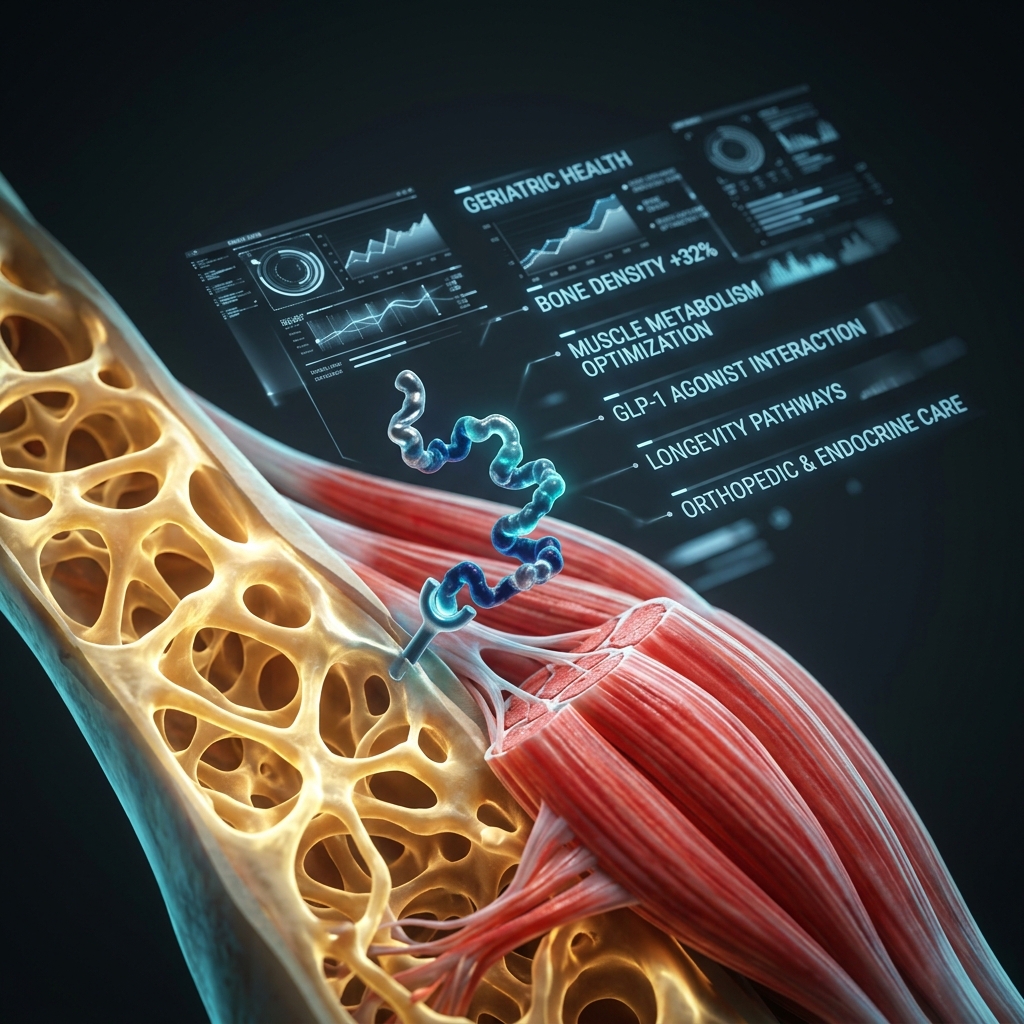
The clinical approach to weight loss completely changes the moment a patient crosses the age of 60. For a 30-year-old, losing 50 pounds of fat while accidentally losing 10 pounds of muscle is a cosmetic annoyance. For a 65-year-old, losing 10 pounds of muscle is a catastrophic orthopedic event that can directly lead to loss of independent living, severe frailty, and fatal fall injuries.
However, the cardiovascular threat of carrying massive visceral fat loads into old age is equally deadly. Seniors are trapped in a biological Catch-22: they must lose the fat to survive, but they cannot afford to lose the muscle required to carry the weight.
In this exhaustive 5,000-word geriatric health guide, we analyze the use of GLP-1 receptor agonists (like Semaglutide and Tirzepatide) in the senior population. We deconstruct the silent killer known as "sarcopenic obesity," detail the strict DEXA-scan protocols required during therapy, and provide a rigid nutritional framework to ensure that weight loss over 60 extends lifespan rather than crippling it.
The Threat of Sarcopenic Obesity
To understand the danger, you must first understand the baseline physiology of aging. By the age of 60, humans naturally lose roughly 1% to 2% of their skeletal muscle mass every single year (a process called sarcopenia). Concurrently, due to plummeting hormones (testosterone in men, estrogen in women), the body naturally accumulates visceral abdominal fat.
When a senior patient is simultaneously obese and severely muscle-depleted, they suffer from Sarcopenic Obesity. This is the most dangerous metabolic state for an older adult. The high body fat places massive mechanical stress on the joints, while the low muscle mass provides zero orthopedic support. This leads directly to knee replacements, shattered hips, and severe mobility loss.
The GLP-1 Risk Vector
When a senior patient is prescribed a GLP-1 medication, the drug violently suppresses appetite, forcing a massive caloric deficit. If the patient simply stops eating, the body will rapidly burn both fat and muscle for energy. In a senior patient who is already suffering from sarcopenia, losing another 15 pounds of skeletal muscle can rapidly push them over the "frailty threshold," meaning they are suddenly too weak to stand up from a chair unassisted.
Safe, Monitored Weight Loss for Seniors
Do not attempt massive weight reduction without geriatric oversight. Connect with U.S.-licensed clinicians trained in muscle preservation.
The Cardiovascular Imperative
If the risk of muscle loss is so high, why do endocrinologists still prescribe Semaglutide to seniors? Because the cardiovascular benefits are impossible to ignore.
As proven by the landmark SELECT Trial (which we analyze deeply in our Cardiovascular GLP-1 Guide), Semaglutide reduces the risk of major adverse cardiovascular events (heart attacks and strokes) by 20% in patients over 45 with preexisting heart disease. Furthermore, GLP-1s rapidly clear visceral fat from the liver and pancreas, reversing Type 2 Diabetes and plummeting blood pressure.
For a 68-year-old on the verge of a fatal myocardial infarction, the GLP-1 is a life-saving intervention. The clinical goal is not to avoid the medication, but to use the medication while deploying an impenetrable anabolic shield to protect the muscle.
Bone Mineral Density (BMD) Protection
Rapid weight loss physically reduces the mechanical load on the skeleton. Without that heavy load, the body assumes it no longer needs thick bones and rapidly sheds bone mineral density, leading to severe osteoporosis. Seniors on GLP-1 therapy MUST undergo baseline and quarterly DEXA scans to monitor bone density. Furthermore, they must supplement heavily with Vitamin D3, Vitamin K2, and Calcium, while engaging in load-bearing resistance training to force the bones to remain dense.
The Geriatric Protocol: How to Protect Your Body
Seniors utilizing Semaglutide or Tirzepatide must abandon traditional "dieting" and treat their nutrition as a precise medical prescription.
1. The Protein Mandate
When a GLP-1 crushes a senior's appetite, they typically gravitate toward eating a small piece of toast or a bowl of soup, because it is easy to digest. This is a fatal error.
Senior patients must prioritize protein above all else. They require a minimum of 1.0 to 1.2 grams of highly bioavailable protein per pound of their target body weight to trigger muscle protein synthesis. Because their stomachs will be paralyzed by the delayed gastric emptying of the medication, they should rely heavily on whey protein isolates or essential amino acid (EAA) supplements that require zero digestion to enter the bloodstream.
2. Resistance Training is Non-Negotiable
Walking is excellent for cardiovascular health, but it does absolutely nothing to prevent sarcopenia. Seniors on a GLP-1 must engage in progressive overload resistance training (using machines, free weights, or heavy resistance bands) at least three times a week. The mechanical tension on the muscle fibers is the only signal that tells the body, "Do not burn this muscle for energy; I still need it to survive."
Medical Weight Loss Done Right
TelehealthFX pairs you with elite U.S. providers who understand the unique metabolic needs of patients over 60, ensuring your weight loss improves your mobility, rather than destroying it.
Peptide Synergy for Seniors
Elite longevity clinics are increasingly prescribing specific peptide therapies alongside GLP-1s for their senior patients to act as an anabolic safety net.
As we discussed in our deep dive into Sermorelin, utilizing a growth-hormone secretagogue can safely restore a senior's natural HGH levels while they sleep. This massive spike in natural growth hormone directly protects the skeletal muscle from catabolism, dramatically improves skin elasticity, and accelerates the healing of the micro-tears caused by their resistance training.
Extend Your Healthspan
Shedding decades of toxic visceral fat is the ultimate longevity strategy, provided you protect your musculoskeletal foundation.
TelehealthFX provides U.S.-licensed, quality-verified compounded Semaglutide and Tirzepatide with strict physician oversight. Learn how to navigate telehealth safely in our guide to spotting Hidden Fees in Telehealth.
Final Clinical Verdict
GLP-1 receptor agonists are profoundly powerful tools for patients over 60, capable of completely reversing metabolic syndrome and dramatically reducing the risk of fatal cardiovascular events. However, because older adults are already battling the natural decay of sarcopenia and osteopenia, rapid weight loss is a highly dangerous endeavor if unmonitored. Seniors must reject traditional diet culture and approach their GLP-1 therapy as a rigorous athletic protocol, prioritizing heavy, bioavailable protein, load-bearing resistance training, and consistent DEXA scans to ensure they are losing the toxic fat without sacrificing the muscle that grants them their independence.
- Baumgartner, R. N. (2000). "Body composition in healthy aging." Annals of the New York Academy of Sciences, 904(1), 437-448. https://nyaspubs.onlinelibrary.wiley.com/doi/abs/10.1111/j.1749-6632.2000.tb06498.x
- Batsis, J. A., & Villareal, D. T. (2018). "Sarcopenic obesity in older adults: aetiology, epidemiology and treatment strategies." Nature Reviews Endocrinology, 14(9), 513-537. https://www.nature.com/articles/s41574-018-0062-9
- Lincoff, A. M., et al. (2023). "Semaglutide and Cardiovascular Outcomes in Obesity without Diabetes." The New England Journal of Medicine, 389, 2221-2232. https://www.nejm.org/doi/full/10.1056/NEJMoa2307563