
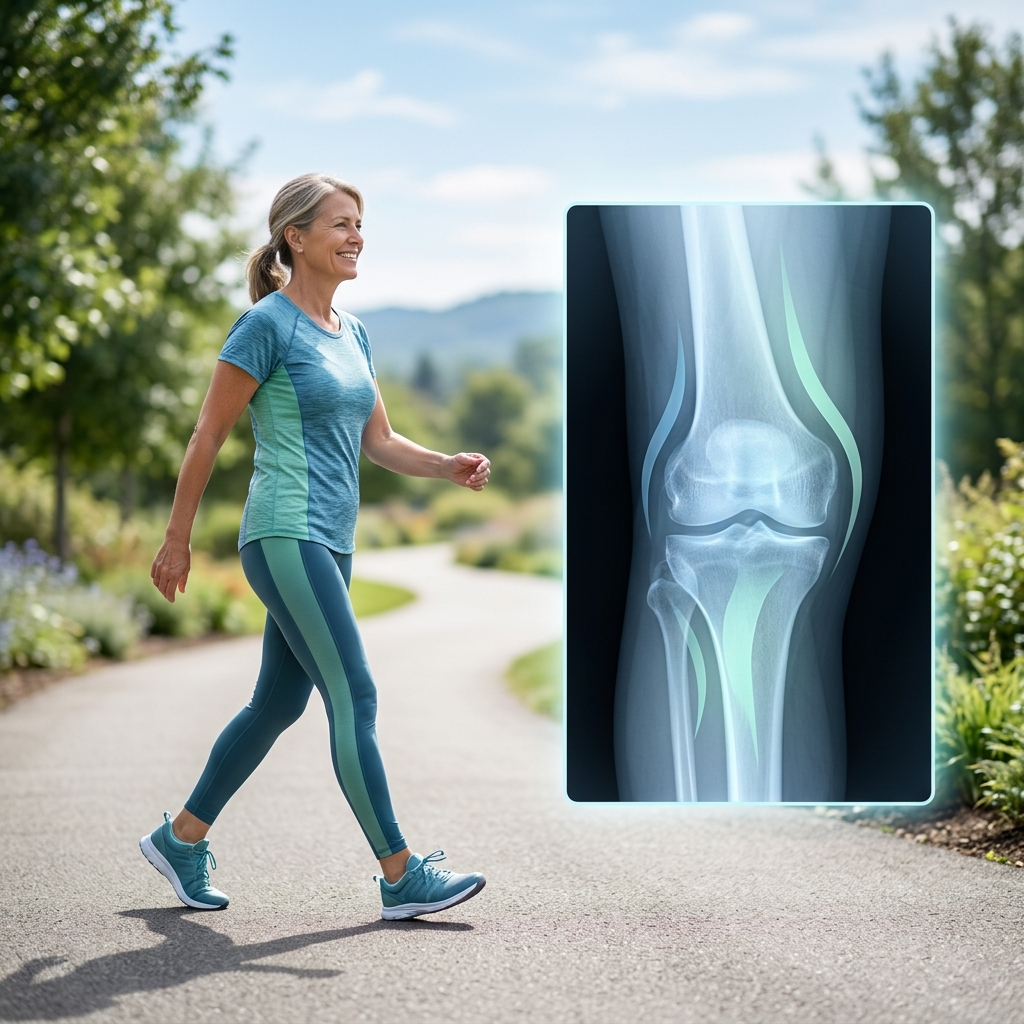
Every pound of body weight puts 4 pounds of pressure on your knees and 6 pounds on your hips with every step. Losing 50 pounds on tirzepatide removes 200 pounds of force from your knees with every single step you take — thousands of times per day. Add GLP-1's direct anti-inflammatory effects, and the impact on joint health is transformative.
The Dual Mechanism: Mechanical + Inflammatory
GLP-1 medications improve joint health through two independent but synergistic pathways:
1. Mechanical Joint Unloading
The relationship between body weight and joint stress is not linear — it is multiplicative. During walking, your knees experience 3–4x your body weight in force. During stairs, 5–7x. During jogging, 8–10x. The math is dramatic:
| Weight Lost | Knee Relief (Walking) | Knee Relief (Stairs) | Approx. GLP-1 Timeline |
|---|---|---|---|
| 10 lbs | –40 lbs force | –60 lbs force | Month 1–2 |
| 25 lbs | –100 lbs force | –150 lbs force | Month 3–4 |
| 50 lbs | –200 lbs force | –300 lbs force | Month 6–8 |
| 75 lbs | –300 lbs force | –450 lbs force | Month 9–12 |
For weight loss timelines, see our semaglutide timeline or tirzepatide timeline.
2. Anti-Inflammatory Effects
GLP-1 reduces systemic inflammation independent of weight loss:
- CRP (C-reactive protein): Reduced 30–40% on GLP-1. CRP is a key marker of systemic inflammation that drives cartilage degradation.
- IL-6 reduction: Interleukin-6 is directly involved in osteoarthritis inflammation. GLP-1 reduces circulating IL-6.
- TNF-α suppression: Tumor necrosis factor alpha drives joint inflammation and bone erosion. GLP-1 modulates this pathway.
The Mobility Cascade Effect
GLP-1's impact on mobility creates a powerful positive feedback loop that patients frequently describe as 'life-changing':
- Weight loss → Less joint pain → More exercise capacity → More weight loss → Even less pain
- Reduced inflammation → Better cartilage health → Improved range of motion → Greater activity tolerance
- Less pain → Better sleep quality → Better recovery → Improved mobility the next day
A 2019 study in Arthritis Care & Research showed that 10% body weight loss reduced knee osteoarthritis pain scores by 28% and physical function scores by 37%. On GLP-1, 10% weight loss typically occurs within 3–4 months.
Move Without Pain Again.
50 lbs lost = 200 lbs less pressure on your knees with every step. GLP-1 from $199/month.
Start Your EvaluationSpecific Conditions That Improve
- Knee osteoarthritis: The most evidence-supported benefit. Weight loss is now considered a first-line treatment for knee OA by the ACR.
- Lower back pain: Excess abdominal weight shifts your center of gravity forward, increasing lumbar spine loading. Weight loss reverses this biomechanical strain.
- Hip osteoarthritis: 6x body weight in force during walking. 50 lbs lost = 300 lbs less hip stress per step.
- Plantar fasciitis: Excess weight is a primary risk factor. Weight loss directly reduces foot loading and inflammation.
- Gout: Weight loss reduces uric acid levels. GLP-1 has been shown to lower serum uric acid through improved renal clearance.
Frequently Asked Questions
Can GLP-1 help me avoid knee replacement surgery?
Potentially. Orthopedic surgeons increasingly recommend weight loss before joint replacement surgery — and some patients find that sufficient weight loss eliminates the need entirely. GLP-1-assisted weight loss is the most effective non-surgical approach available.
My joint pain makes it hard to exercise. Will GLP-1 still work?
Yes. GLP-1's primary mechanism is appetite suppression, not exercise. Weight loss occurs regardless of exercise capacity. As weight drops and pain decreases, you can gradually add activity. Start with low-impact options: swimming, recumbent cycling, or seated exercises.
How quickly will I notice joint pain improvement?
Most patients report noticeable pain reduction within 4–8 weeks, corresponding to the first 10–15 lbs of weight loss. For our first week guide, see here. Significant improvement (stairs, walking distances) typically occurs by month 3–4.
Your Knees Will Thank You.
Compounded semaglutide from $199/mo. Tirzepatide from $349/mo. Month-to-month. Clinician-guided.
Get StartedReferences
- Messier, S. P., et al. (2019). Effect of diet and exercise on knee OA. Arthritis Care & Research, 71(2), 268–278.
- Kolasinski, S. L., et al. (2020). ACR/AF guideline for management of osteoarthritis. Arthritis & Rheumatology, 72(2), 220–233.