
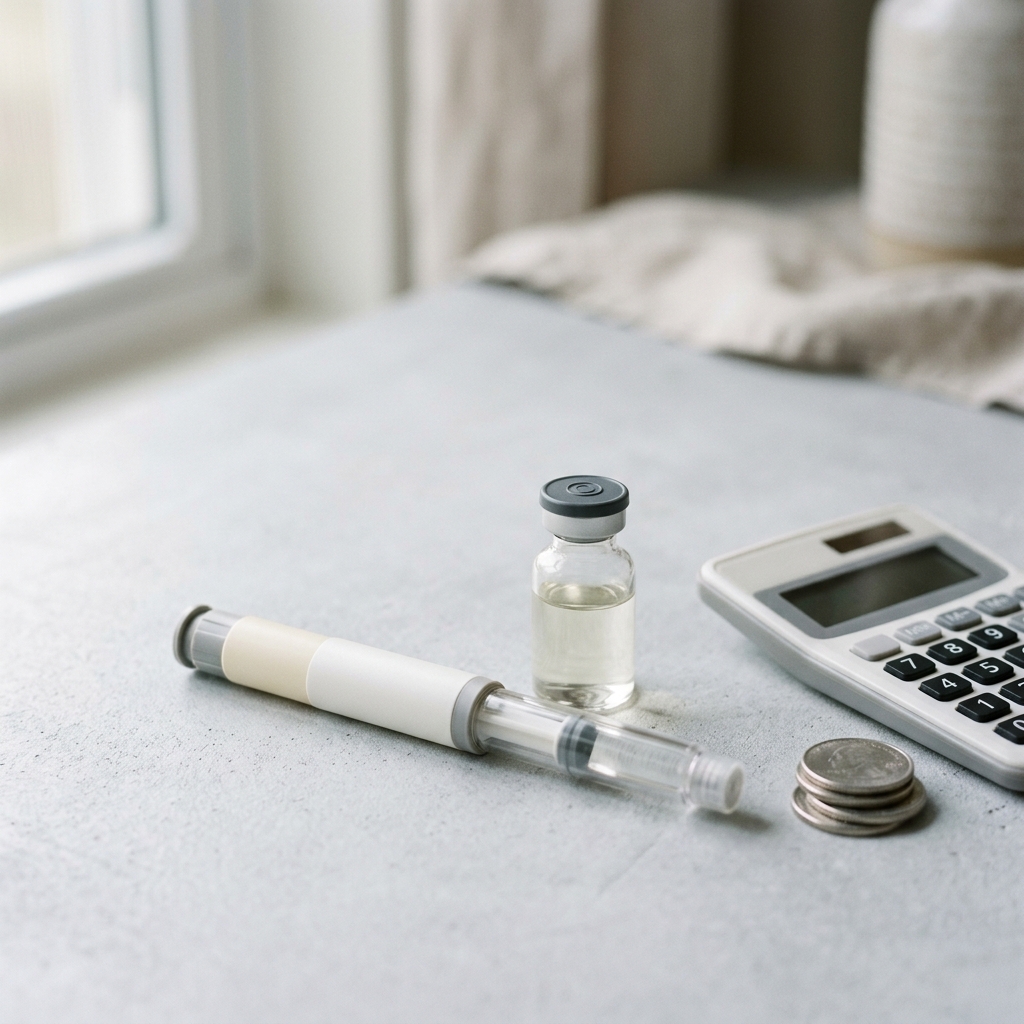
GLP-1 pricing is one of the most confusing things about starting treatment, because the same medication can cost anywhere from almost nothing to well over a thousand dollars a month depending entirely on how you pay for it. The good news: the landscape shifted hard in your favor over 2025, and there are now several legitimate routes that didn't exist a year or two ago. Here's what semaglutide and tirzepatide actually cost in 2026, and how to find your lowest-cost option.
The short answer
There is no single price. What you pay depends on which of four routes you use:
- Brand-name retail with no help: roughly $1,000–$1,350 per month — the "sticker" price almost nobody actually needs to pay anymore.
- Manufacturer direct self-pay: roughly $349–$499 per month for cash-paying patients through the drugmakers' own pharmacies.
- With commercial insurance plus a savings card: anywhere from $0 to a few hundred dollars per month, if your plan covers it.
- Compounded versions: these were the cheapest option during the shortage, but their availability changed substantially in 2025.
Find out what you'd actually pay — in about 2 minutes.
A licensed provider reviews your situation and identifies the most affordable GLP-1 option available to you in 2026.
Check Your Eligibility & PricingCost at a glance (2026)
| Medication | Brand retail (no coverage) | Manufacturer self-pay | With covered insurance + savings card |
|---|---|---|---|
| Wegovy (semaglutide) | ~$1,300+/mo | ~$499/mo via NovoCare | as low as $0–$25/mo |
| Ozempic (semaglutide) | ~$950+/mo | varies | as low as $25/mo |
| Zepbound (tirzepatide) | ~$1,050+/mo | ~$349–$499/mo via LillyDirect | as low as $25/mo |
| Mounjaro (tirzepatide) | ~$1,050+/mo | varies | as low as $25/mo |
Prices are approximate and change frequently. Always confirm the current figure with the manufacturer or your pharmacy.
The four ways to pay, explained

1. Through insurance (if it's covered)
If your insurance covers a GLP-1 for your situation, this is usually the cheapest route — copays can run anywhere from $0 to a few hundred dollars a month. The catch is coverage itself. Many plans cover these drugs for type 2 diabetes (Ozempic, Mounjaro) but exclude or restrict them for weight management (Wegovy, Zepbound), and most require prior authorization, meaning your provider has to document that you meet specific medical criteria before the plan pays. It's worth checking your formulary directly, because two people on the "same" plan tier can have very different out-of-pocket costs.
2. Manufacturer savings cards
If you have commercial (non-government) insurance, the drugmakers offer savings cards that can dramatically lower your copay — in some cases to as little as $0–$25 per month. These cards generally can't be used with Medicare, Medicaid, or other government coverage. They're one of the most underused cost-savers, and eligibility takes only a few minutes to check on the manufacturer's site.
3. Manufacturer direct self-pay (the big 2025 change)
This is the route that reshaped affordability for people without coverage. Both major manufacturers now sell directly to cash-paying patients at far below retail. Novo Nordisk offers self-pay Wegovy through its NovoCare pharmacy at around $499 per month for self-paying patients, and Eli Lilly sells single-dose Zepbound vials through LillyDirect at roughly $349–$499 per month depending on the dose. These programs are aimed squarely at people whose insurance won't cover weight-loss treatment, and they've effectively replaced the role compounded versions used to play.
4. Compounded semaglutide and tirzepatide
During the 2023–2024 shortages, compounded versions were widely available through telehealth platforms for roughly $150–$300 a month, and for a while they were the cheapest path by a wide margin. That changed in 2025. Once the shortages officially resolved and both drugs came off the FDA shortage list, the exemption that allowed large-scale compounding expired. Routine compounding of these medications purely as a budget alternative is no longer permitted, though limited prescriber-driven compounding for a documented individual clinical need can still exist in specific cases.
It's also worth knowing what compounded products are: they are not FDA-approved, and the FDA does not evaluate them for safety, effectiveness, or quality.
Not sure which route is cheapest for you?
A licensed provider reviews your coverage, your health history, and your eligibility — then identifies the most affordable path to treatment.
Check Your OptionsNo obligation — you only move forward if a provider determines you're a candidate.
What's the cheapest way to get semaglutide or tirzepatide in 2026?
For most people, the genuinely cheapest legitimate route now breaks down like this:
If you have commercial insurance, start by checking whether your plan covers the medication and stack a manufacturer savings card on top — that combination produces the lowest out-of-pocket cost when it works, sometimes near $0.
If you don't have coverage, or your plan excludes weight-loss medication, the manufacturer direct self-pay programs (around $349–$499 a month) are now the most affordable reliable option, and they're FDA-approved products rather than compounded ones.
The "cheapest compounded semaglutide" route that dominated 2024 is the one that's no longer the simple budget play it used to be. If you find an offer still marketing bulk compounded GLP-1 at shortage-era prices, it's worth looking closely at whether that's actually permitted in 2026.
What does it cost without insurance?

This is the most common question, and the answer in 2026 is more encouraging than it was a year ago. Without insurance, you're choosing mainly between brand-name retail (the full ~$1,000+ price, which you should almost never have to pay) and the manufacturer self-pay programs (~$349–$499/month). For a cash payer, those direct programs are the headline number to focus on — they brought a real, FDA-approved GLP-1 within reach for people whose insurance offers no help at all.
Find your lowest-cost option
The fastest way to land on your actual price — not a range — is to have a licensed provider review your situation, your coverage, and your eligibility, then identify the most affordable route available to you. A short online eligibility check connects you with a licensed provider who can do exactly that and determine whether a GLP-1 treatment plan is appropriate for you.
Check your eligibility and pricing — takes about 2 minutes
There's no obligation, and you only move forward if a provider determines you're a candidate.
Frequently asked questions
How much does tirzepatide cost in 2026?
Brand-name tirzepatide (Zepbound or Mounjaro) retails for roughly $1,050 a month without coverage, but self-paying patients can get single-dose Zepbound vials through the manufacturer for around $349–$499 a month, and those with covered insurance plus a savings card may pay as little as $25.
How much does semaglutide cost?
Brand-name semaglutide (Wegovy or Ozempic) retails for roughly $950–$1,350 a month, but Wegovy is available to self-paying patients for about $499 a month through the manufacturer, and covered insurance with a savings card can bring it down to $0–$25.
What is the cost of GLP-1 without insurance?
Without insurance, the most affordable reliable option in 2026 is a manufacturer direct self-pay program, roughly $349–$499 a month for an FDA-approved product — far below the $1,000-plus retail price.
Is compounded semaglutide cheaper?
It was significantly cheaper during the 2023–2024 shortage, but after the shortages resolved in 2025 the rules changed and routine compounding is no longer permitted. For most people the manufacturer self-pay programs are now both affordable and FDA-approved.
Why is Wegovy so expensive?
The list price reflects how the drug is priced before insurance and manufacturer programs. Very few patients pay the full retail amount — most use insurance, a savings card, or a self-pay program that brings the real cost far lower.
Can I use a savings card with Medicare?
Generally no. Manufacturer savings cards are typically limited to commercial insurance and can't be combined with Medicare, Medicaid, or other government coverage.
Find your actual price — takes about 2 minutes.
A licensed provider reviews your health history, coverage, and eligibility to determine the most affordable GLP-1 treatment available to you in 2026.
Check Your Eligibility & PricingSources
Pricing reflects publicly available manufacturer information as of the last-updated date above and is subject to change. Confirm current pricing directly with the manufacturer.
- Novo Nordisk. (2026). NovoCare. novocare.com
- Eli Lilly and Company. (2026). Zepbound. zepbound.lilly.com
- U.S. Food and Drug Administration. (2026). FDA drug shortages database. dps.fda.gov/drugshortages
Medical disclaimer: This page is for general informational purposes only and is not medical advice. It does not establish a provider-patient relationship. Treatment and pricing decisions are made only by a licensed medical provider and your pharmacy based on your individual situation. Always consult a qualified healthcare professional before starting any medication.
Pricing disclaimer: All prices are approximate, vary by dose, pharmacy, location, and coverage, and change frequently. The figures here are illustrative and not a quote. Confirm current pricing with the manufacturer or pharmacy.
Compounded-medication disclaimer: Compounded medications (including compounded semaglutide and tirzepatide) are not FDA-approved. The FDA does not evaluate compounded drugs for safety, effectiveness, or quality.
Affiliate disclaimer: Telehealth FX is an informational website. It is not a medical provider or pharmacy and does not provide medical advice, diagnosis, or treatment. We may earn a commission when you sign up for a partner's service through links on this site.
Trademark note: "Wegovy," "Ozempic," "Zepbound," and "Mounjaro" are the property of their respective owners. This page is not affiliated with, endorsed by, or sponsored by their manufacturers.