
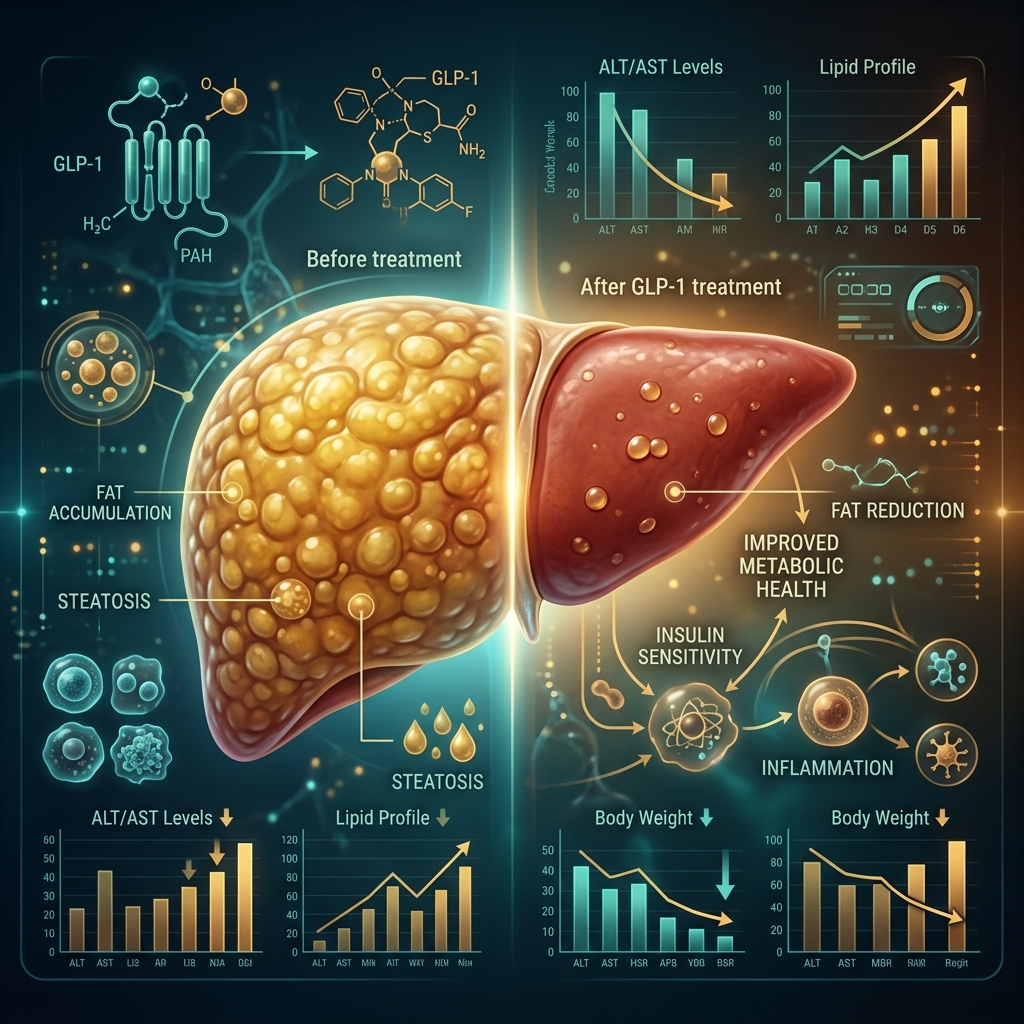
100 million Americans have non-alcoholic fatty liver disease (NAFLD). Until recently, the only treatment was 'lose weight' — advice that is medically accurate but practically unhelpful. Now, GLP-1 medications are showing the most promising liver-specific results of any pharmaceutical intervention: semaglutide resolved MASH (the inflammatory, fibrosis-causing form) in 59% of patients in the landmark Newsome trial.
Understanding NAFLD and MASH
Fatty liver disease exists on a spectrum, and the terminology recently changed (NAFLD → MASLD, NASH → MASH):
- Simple steatosis (MASLD/NAFLD): Fat accumulation in the liver. Affects 30–40% of U.S. adults. Often asymptomatic. Reversible with weight loss.
- Steatohepatitis (MASH/NASH): Fat + inflammation + cell damage. Affects ~5% of U.S. adults. Can progress to fibrosis and cirrhosis. This is the dangerous stage.
- Fibrosis → Cirrhosis: Scar tissue accumulation. Eventually leads to liver failure, liver cancer, or transplant need. Largely irreversible once advanced.
The metabolic connection is direct: insulin resistance drives fat into the liver. GLP-1 medications improve insulin sensitivity, reduce hepatic fat, and address the root cause. This is the same mechanism that helps with prediabetes and metabolic syndrome.
The Clinical Evidence
| Metric | Semaglutide Result | Placebo |
|---|---|---|
| MASH resolution | 59% | 17% |
| Fibrosis improvement | 43% | 33% |
| Liver fat reduction (MRI-PDFF) | 50–70% | Minimal |
| ALT normalization | 60–70% | ~30% |
| Weight loss | 13% (in MASH population) | 1% |
Source: Newsome, P. N., et al. (2021). Semaglutide in patients with non-alcoholic steatohepatitis. NEJM, 384(12), 1113–1124.
How GLP-1 Reverses Fatty Liver: The Mechanism
GLP-1 does not simply reduce liver fat through weight loss. There are direct hepatic effects:
- Reduced hepatic lipogenesis: GLP-1 directly decreases de novo fat production in liver cells by suppressing SREBP-1c and ACC enzyme activity.
- Improved insulin signaling: Hepatic insulin resistance drives fat accumulation. GLP-1 restores insulin sensitivity in liver cells, redirecting glucose from fat storage to energy utilization.
- Reduced inflammation: GLP-1 suppresses NF-κB inflammatory signaling in hepatocytes, reducing the transition from simple steatosis to MASH. This parallels its systemic anti-inflammatory effects.
- Reduced oxidative stress: GLP-1 receptor activation increases hepatic antioxidant defenses, protecting liver cells from the oxidative damage that drives fibrosis.
- Visceral fat reduction: GLP-1 preferentially reduces visceral (organ) fat, including the portal vein fat that delivers free fatty acids directly to the liver.
Weight Loss + Liver Healing. One Medication.
GLP-1 addresses NAFLD/MASH at the root — reducing visceral fat, hepatic insulin resistance, and liver inflammation simultaneously. From $199/month.
Start Your EvaluationWho Should Consider GLP-1 for Liver Health?
While GLP-1 is prescribed primarily for weight management, liver health benefits are a significant co-benefit for patients with:
- Elevated liver enzymes (ALT/AST): If your bloodwork shows elevated transaminases, this may indicate fatty liver inflammation. GLP-1 normalizes these in 60–70% of cases.
- Ultrasound-confirmed fatty liver: Your doctor may have noted hepatic steatosis on imaging. GLP-1 reduces liver fat content by 50–70%.
- Insulin resistance or prediabetes: Insulin resistance is the primary driver of NAFLD. GLP-1 addresses both conditions simultaneously.
- Central obesity (BMI 30+ with high waist circumference): Visceral fat strongly correlates with hepatic fat. Eligibility guide.
Frequently Asked Questions
Is semaglutide FDA-approved for fatty liver disease?
Not yet specifically for NAFLD/MASH, although phase 3 ESSENCE trials are underway for a potential MASH indication. Currently, GLP-1 is prescribed for weight management, and liver improvement is a documented co-benefit.
How long until I see liver enzyme improvement?
ALT/AST levels typically begin normalizing within 12–24 weeks of starting GLP-1 medication, correlating with the weight loss timeline. See our semaglutide timeline.
Is tirzepatide better than semaglutide for liver health?
Early data suggests tirzepatide may have superior liver outcomes due to the GIP co-agonist effect and greater overall weight loss, but head-to-head MASH trials are still ongoing. Both produce significant improvements. See our decision guide.
59% MASH Resolution. The Data Speaks.
Compounded semaglutide from $199/mo. Tirzepatide from $349/mo. Clinician-guided. No insurance required.
Get StartedReferences
- Newsome, P. N., et al. (2021). A placebo-controlled trial of subcutaneous semaglutide in nonalcoholic steatohepatitis. NEJM, 384(12), 1113–1124.
- Loomba, R., et al. (2023). Semaglutide 2.4 mg and liver fat: STEP sub-analysis. Hepatology.
- American Liver Foundation. (2024). NAFLD prevalence data. liverfoundation.org