
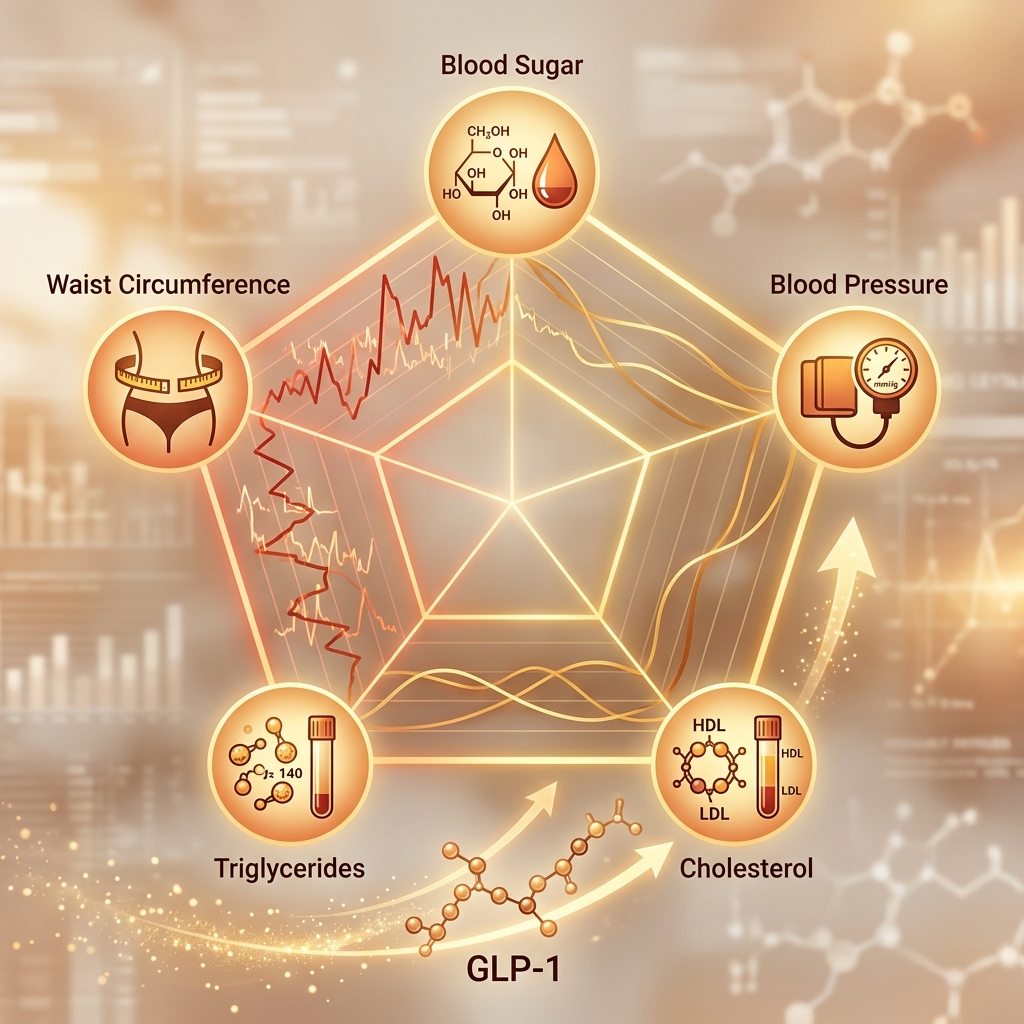
Metabolic syndrome affects 1 in 3 American adults — approximately 85 million people. It is diagnosed when you meet 3 of 5 criteria: elevated waist circumference, high triglycerides, low HDL cholesterol, high blood pressure, and high fasting glucose. Traditionally, treating metabolic syndrome requires 3–5 separate medications: a statin, a blood pressure drug, metformin, a triglyceride-lowering agent, and possibly aspirin. GLP-1 addresses all five risk factors simultaneously with a single weekly injection.
What Is Metabolic Syndrome?
Metabolic syndrome is not a single disease — it is a cluster of interconnected risk factors that dramatically increase your risk of heart disease, stroke, and type 2 diabetes. You need 3 of these 5 to qualify:
| Criterion | Threshold | GLP-1 Effect | Magnitude |
|---|---|---|---|
| Waist circumference | ≥40 in (men) / ≥35 in (women) | Significant reduction | 4–6 inches average |
| Triglycerides | ≥150 mg/dL | Reduced 20–30% | –30 to –60 mg/dL |
| HDL cholesterol | <40 (men) / <50 (women) | Modestly increased | +3 to +5 mg/dL |
| Blood pressure | ≥130/85 mmHg | Reduced | –5 to –8 mmHg systolic |
| Fasting glucose | ≥100 mg/dL | Dramatically improved | Normalization in many patients |
How GLP-1 Addresses Each Factor (Mechanism Deep-Dive)
1. Waist Circumference (Visceral Fat)
GLP-1 produces 14.9–22.5% total body weight loss, with preferential reduction in visceral (organ) fat. MRI sub-studies show visceral adipose tissue decreases 30–40% — disproportionate to total weight loss. This matters because visceral fat is the metabolically active fat that secretes inflammatory cytokines, drives insulin resistance, and deposits fat in the liver. See our fatty liver guide.
2. Triglycerides
Elevated triglycerides are driven by insulin resistance, excess carbohydrate intake, and visceral fat. GLP-1 addresses all three: improving insulin sensitivity, naturally reducing food intake (especially high-carbohydrate cravings), and reducing the visceral fat that produces triglyceride-rich lipoproteins. Average 20–30% reduction in STEP/SURMOUNT trials.
3. HDL Cholesterol
GLP-1's effect on HDL is more modest (3–5 mg/dL increase) but meaningful for patients near the threshold. The improvement comes primarily from weight loss, increased physical activity enabled by reduced joint pain, and improved lipid metabolism.
4. Blood Pressure
GLP-1 reduces systolic blood pressure by 5–8 mmHg on average — comparable to adding a mild antihypertensive medication. The mechanism is multifactorial: weight loss reduces blood volume and vascular resistance, improved insulin sensitivity reduces sodium retention, and direct GLP-1 receptor effects on renal sodium handling. The SELECT trial confirmed these blood pressure benefits.
5. Fasting Glucose
This is GLP-1's strongest metabolic effect. Semaglutide was originally developed for type 2 diabetes, where it produces HbA1c reductions of 1.5–2.0 percentage points. For prediabetes patients, GLP-1 frequently normalizes fasting glucose entirely, potentially preventing progression to type 2 diabetes. See our diabetes guide.
Five Problems. One Solution. One Injection Per Week.
GLP-1 may replace 3–5 separate medications for metabolic syndrome. From $199/month. HSA/FSA accepted.
Start Your EvaluationThe Medication Reduction Opportunity
Many metabolic syndrome patients are on multiple medications. GLP-1 can potentially reduce the total medication burden:
- Metformin: May become unnecessary as glucose normalizes — discuss with your doctor
- Blood pressure medications: As BP drops, your doctor may reduce or eliminate antihypertensives
- Statins: Lipid improvements may allow dose reduction (never self-discontinue)
- Sleep apnea treatment: CPAP dependency may decrease — see our sleep guide
Important: Never stop or reduce any medication without explicit clinician guidance.
Frequently Asked Questions
Can GLP-1 cure metabolic syndrome?
'Resolve' is more accurate than 'cure.' Sustained GLP-1-assisted weight loss can normalize all 5 metabolic syndrome criteria, effectively reversing the diagnosis. Whether this persists after stopping GLP-1 depends on weight maintenance — see our rebound prevention guide.
Is tirzepatide better for metabolic syndrome?
Tirzepatide's dual GLP-1/GIP mechanism may offer slightly better insulin sensitivity improvement and greater weight loss. However, both semaglutide and tirzepatide significantly improve all 5 metabolic criteria. Cost may be the deciding factor — see our decision guide.
How quickly will my bloodwork improve?
Fasting glucose and triglycerides typically improve within 4–8 weeks. Blood pressure reduction is noticeable by 4–12 weeks. Waist circumference and HDL take longer — 3–6 months for clinically meaningful changes. We recommend bloodwork at baseline, 3 months, and 6 months.
Reverse the Syndrome. Not Just the Symptoms.
Compounded semaglutide from $199/mo. Tirzepatide from $349/mo. Clinician-guided. Month-to-month.
Get StartedReferences
- Grundy, S. M., et al. (2005). Diagnosis and management of metabolic syndrome (AHA/NHLBI). Circulation, 112(17), 2735–2752.
- Wilding, J. P. H., et al. (2021). Semaglutide in adults with overweight or obesity (STEP 1). NEJM, 384(11), 989–1002.
- Jastreboff, A. M., et al. (2022). Tirzepatide for obesity (SURMOUNT-1). NEJM, 387(3), 205–216.