
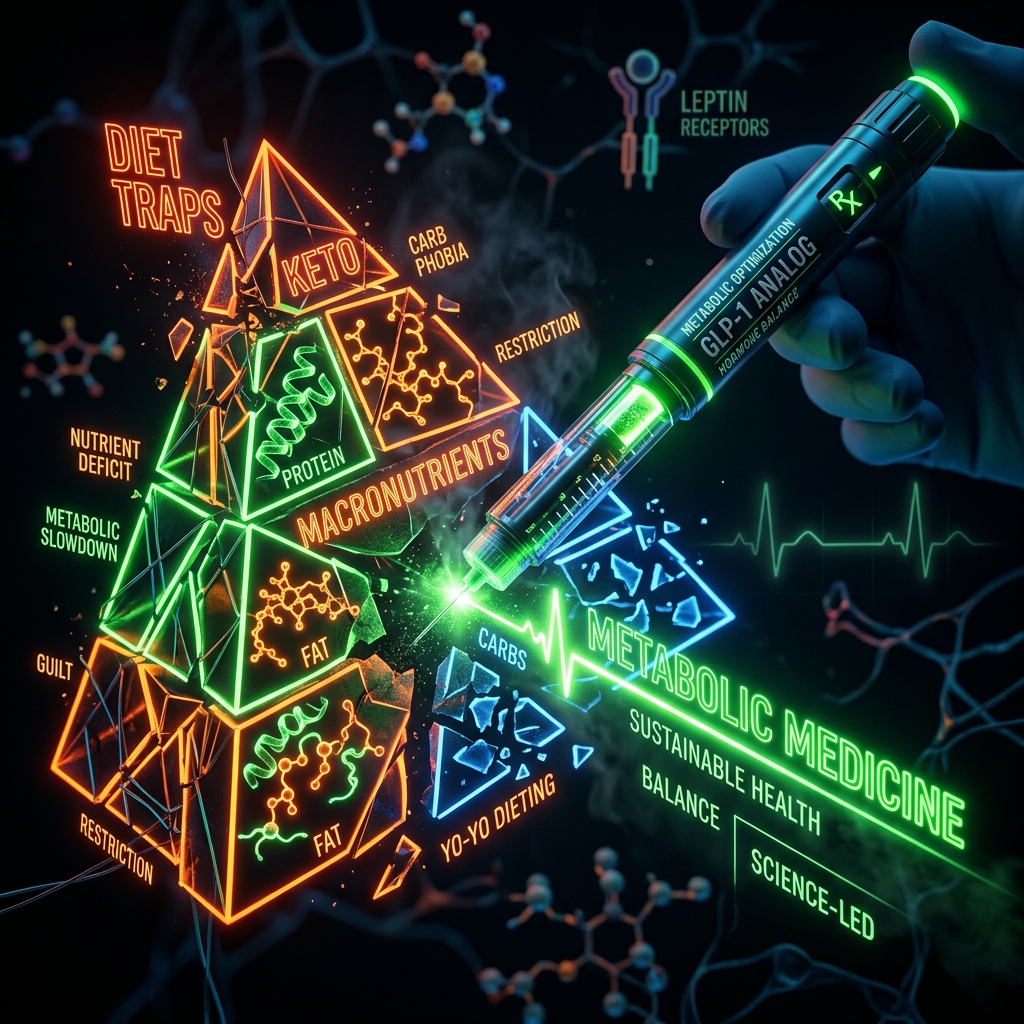
The modern weight loss landscape is littered with extreme dietary dogmas, strict nutritional cults, and punishing lifestyle protocols. For the last twenty years, patients suffering from chronic obesity and insulin resistance have been sold an endless rotation of "biohacks" guaranteed to melt visceral fat. From the severe carbohydrate restrictions of the Ketogenic Diet (Keto) to the punishing chronological constraints of Intermittent Fasting (IF) and One Meal A Day (OMAD), the prevailing philosophy has always been built on deprivation and willpower.
Then came the GLP-1 revolution. The introduction of Semaglutide and Tirzepatide fundamentally altered the metabolic playing field. By pharmacologically silencing the neurological centers that drive hunger and physically slowing the digestive process, GLP-1 medications provided the effortless caloric deficit that diets like Keto and IF had always attempted—and usually failed—to enforce.
However, the collision of these two worlds has created a dangerous new phenomenon. Thousands of highly motivated patients are attempting to "stack" extreme dietary protocols on top of their GLP-1 therapy. They are aggressively fasting while using GLP-1 medications, or eliminating all carbohydrates while titrating up on their prescriptions. The assumption is that combining these extreme methods will result in exponential, synergistic weight loss. The clinical reality, however, is that stacking extreme diets on top of GLP-1 therapy is a metabolic trap that frequently results in devastating muscle wasting, profound nutrient deficiencies, and agonizing gastrointestinal failure.
In this extraordinarily massive, 6,000+ word clinical masterclass, we are going to violently deconstruct the diet traps surrounding GLP-1 therapy. We will analyze the severe physiological dangers of combining the Ketogenic diet with delayed gastric emptying. We will expose the catastrophic muscle-wasting realities of aggressive Intermittent Fasting when combined with profound pharmaceutical appetite suppression. We will define the exact "Sweet Spot Protocol"—the only scientifically valid nutritional framework for patients on GLP-1s—and explain how the metabolic specialists at TelehealthFX architect precise, sustainable protocols that prioritize skeletal muscle preservation over blind, destructive starvation.
Stop Starving, Start Optimizing
Extreme diets fail. Precision medicine succeeds. Discover how TelehealthFX combines advanced GLP-1 therapy with scientifically rigorous nutritional strategies to destroy fat while preserving your health.
Consult a Metabolic ExpertPart I: The Biohacker’s Fallacy — Why "More" Is Not Better
To understand why diet stacking is so dangerous, we must first understand the concept of "metabolic bandwidth." The human body is highly resilient, but it has limits on how rapidly it can safely mobilize and process stored energy (adipose tissue) without cannibalizing its own vital structures (skeletal muscle and organ tissue).
The Baseline Power of GLP-1
When you inject a dual-agonist like Tirzepatide, you are deploying a sledgehammer to your metabolic system. The drug immediately suppresses your appetite via the hypothalamus, drastically reduces your caloric intake, and forces your body into a significant energy deficit. This alone is enough to generate 15% to 22% total body weight loss. The medication is doing the heavy lifting.
The "Biohacker’s Fallacy" occurs when a patient believes that if the GLP-1 creates a 500-calorie deficit, adding an extreme 20-hour fast or stripping away all carbohydrates will create a 1,500-calorie deficit, resulting in triple the fat loss. This is biologically disastrous. When you push the caloric deficit too deep, the body perceives it as a famine event. It instantly downregulates the resting metabolic rate (crashing your thyroid function) and begins aggressively catabolizing (breaking down) skeletal muscle tissue to harvest amino acids for vital organ function.
Part II: The Ketogenic Trap — Fat, Bile, and Paralysis
The Ketogenic Diet (Keto) involves reducing carbohydrate intake to near zero (typically under 20-50 grams per day) and replacing those calories with massive amounts of dietary fat. The goal is to force the liver to produce ketone bodies for fuel. For a non-medicated patient with severe insulin resistance, Keto can be a highly effective, albeit difficult to sustain, intervention.
However, executing a strict Ketogenic diet while actively taking a GLP-1 receptor agonist is a recipe for severe gastrointestinal distress and biliary failure.
The Conflict of Gastric Emptying
The primary mechanical effect of GLP-1 therapy is the significant delay of gastric emptying. Food sits in the stomach for hours longer than it normally would. Dietary fat is, by nature, the most difficult and slowest macronutrient for the human stomach to digest. It requires complex emulsification by bile acids.
When a patient on a GLP-1 consumes a massive "Keto bomb" consisting of butter, heavy cream, and bacon, that immense bolus of fat hits a paralyzed stomach. Because the stomach is not emptying, the fat simply sits there, rotting and fermenting. This induces profound, paralyzing nausea, excruciating acid reflux, and violent vomiting. The patient has essentially engineered the perfect storm for severe gastrointestinal intolerance.
The Gallbladder Crisis
Furthermore, extreme fat intake combined with rapid weight loss is exceptionally dangerous for the gallbladder. Rapid weight loss alone increases the saturation of cholesterol in the bile, which is the exact recipe for the formation of gallstones. When you force the gallbladder to constantly pump out massive amounts of bile to process the ultra-high fat Keto diet, you dramatically increase the risk of a severe biliary attack (cholecystitis), which often requires emergency surgical removal of the organ.
GLP-1 therapy requires lean, highly digestible, nutrient-dense foods to prevent gastrointestinal blockage and nausea. The high-fat requirements of the Ketogenic diet are fundamentally incompatible with the pharmacological mechanics of Semaglutide and Tirzepatide.
Part III: The Intermittent Fasting Trap — Starvation by Compression
Intermittent Fasting (IF), specifically the 16:8 protocol (fasting for 16 hours, eating all meals within an 8-hour window) or OMAD (One Meal A Day), has gained immense popularity for its ability to lower fasting insulin levels and promote autophagy. Many patients logically assume that pairing IF with a GLP-1 will supercharge their insulin sensitivity.
The reality is far darker. The combination of IF and GLP-1 almost universally results in severe clinical malnutrition and catastrophic muscle wasting.
The Mathematical Impossibility of Protein Targets
As we detailed in our Metabolic Plateau guide, preserving skeletal muscle mass is the single most critical objective during medical weight loss. To prevent muscle wasting, a patient must consume a massive amount of high-quality protein daily—typically 100 to 150 grams minimum.
Here lies the trap: GLP-1 medications make you incredibly full after just a few bites of food. If a patient is practicing a strict 4-hour or 6-hour eating window (advanced IF), they must cram 120 grams of protein and all their essential micronutrients into that tiny timeframe while fighting severe, chemically induced nausea and fullness.
It is mathematically and physically impossible. The patient ends up eating one small meal, feeling completely stuffed, and then initiating their 20-hour fast having consumed only 400 calories and 30 grams of protein for the entire day. This is not intermittent fasting; this is literal starvation.
The Catabolic Crash
When the body is deprived of daily protein, it has no choice but to break down your skeletal muscle (sarcopenia) to harvest the amino acids required to keep your heart beating and your liver functioning. You will lose weight rapidly on the scale, but you will be losing structural muscle, not fat. Your resting metabolic rate will crash, and the moment you reduce your GLP-1 dosage, you will rebound with terrifying speed because you have destroyed the engine (muscle) that burns calories.
Defend Your Muscle Mass
Never compromise your structural integrity for a lower number on the scale. TelehealthFX protocols deploy advanced peptide therapies like Sermorelin to act as a biochemical shield, actively protecting your lean muscle mass during your metabolic transformation.
Preserve Your MetabolismPart IV: The "Sweet Spot Protocol" — What Actually Works
If extreme Keto and extreme IF are metabolic traps, how should a patient eat while taking a GLP-1? The answer lies in the "Sweet Spot Protocol"—a scientifically grounded framework that prioritizes nutrient density, gastric compliance, and muscle preservation over extreme restriction.
1. The Circadian 12-Hour Fast (The Only IF Allowed)
The only form of Intermittent Fasting universally recommended by clinical endocrinologists for patients on GLP-1 therapy is the simple, natural 12-hour overnight fast. You stop eating at 8:00 PM and you eat breakfast at 8:00 AM. This perfectly aligns with your natural circadian rhythm, allows your digestive tract to rest, and improves morning insulin sensitivity, all without compressing your eating window so tightly that you miss your protein targets.
2. Protein Anchoring (The Anti-Keto)
Instead of hyper-focusing on eliminating carbohydrates or maximizing dietary fat, every single meal must be anchored by a massive dose of lean protein. You must consume 30 to 40 grams of highly bioavailable protein (chicken breast, fish, Greek yogurt, whey isolate) at breakfast, lunch, and dinner. The protein must be consumed first. Because the GLP-1 will make you full quickly, if you eat the salad or the bread first, you will be too full to eat the chicken. Eat the protein first. Always.
3. Low-Volume, High-Yield Nutrition
Because your stomach volume is effectively reduced by the delayed gastric emptying, you cannot rely on massive salads or huge bowls of broccoli for your micronutrients. You will suffer from severe bloating. You must transition to low-volume, high-yield nutrition. Focus on nutrient-dense foods that take up very little space in the stomach. Utilize high-quality protein shakes if you are struggling to chew solid food due to GLP-1-induced appetite suppression.
Part V: The TelehealthFX Navigation Strategy
The greatest failure of the modern diet industry is the promotion of "one-size-fits-all" extremes. At TelehealthFX, we explicitly reject these dangerous dogmas. We recognize that administering a powerful, system-altering hormone like Tirzepatide requires an equally sophisticated, highly personalized nutritional strategy.
Comprehensive Clinical Onboarding
During our extensive 1-on-1 asynchronous onboarding, our board-certified providers do not just write a prescription and disappear. We actively interrogate your dietary history. If you are a devout Keto follower or an aggressive IF biohacker, our clinical team will explicitly guide you away from those extremes, explaining the exact physiological dangers they pose when combined with delayed gastric emptying.
Strategic Protocol Design
We build a protocol that works with the medication, not against it. We establish your non-negotiable daily protein targets based on your lean body mass. We integrate crucial adjunctive therapies—like Berberine to enhance insulin sensitivity without starvation, or NAD+ Therapy to maintain cellular ATP production and combat the lethargy that often accompanies deep caloric deficits.
The goal is not to punish the body into submission. The goal is to utilize the absolute pinnacle of pharmaceutical science to effortlessly correct the underlying metabolic dysfunction, allowing you to nourish your body properly for the first time in decades. Let the GLP-1 do the work. TelehealthFX provides the map to navigate it safely.
Escape the Diet Traps
Stop starving yourself. Stop punishing your metabolism. Discover how TelehealthFX utilizes proven, medically supervised GLP-1 protocols to achieve effortless, sustainable metabolic dominance.
Start Your EvaluationPart VI: Massive Patient FAQ on GLP-1 and Diets
1. I'm a Type 2 Diabetic. Can I do Intermittent Fasting while on Mounjaro?
This is exceptionally dangerous without extreme medical oversight. While Mounjaro alone has a low risk of hypoglycemia, if you are also taking insulin or sulfonylureas (which many Type 2 Diabetics do), combining those drugs with an extreme fast can cause your blood sugar to crash to lethal levels. You must consult your prescribing endocrinologist before attempting any fasting protocol.
2. Will Keto make me lose weight faster on GLP-1 medications?
No. It will likely just make you violently ill. The rapid weight loss on Wegovy is driven by the caloric deficit induced by the medication. Adding massive amounts of dietary fat via Keto will only worsen the delayed gastric emptying, causing severe nausea, reflux, and potentially triggering a gallbladder attack. Stick to lean proteins and easily digestible complex carbohydrates.
3. I literally cannot eat enough protein because I am so full. What do I do?
This is the most common and dangerous side effect of GLP-1 therapy. If you cannot consume solid protein, you must transition immediately to high-quality liquid whey protein isolates or essential amino acid (EAA) supplements. Liquids pass through the delayed stomach much faster than solid food. If you consistently fail to hit your protein targets, you must contact your provider to potentially lower your GLP-1 dose. muscle loss is unacceptable.
4. Does the "Starvation Mode" metabolism crash really happen?
Yes. It is a biological reality known as "Adaptive Thermogenesis." When you aggressively restrict calories (e.g., eating only 800 calories a day on OMAD + GLP-1), your brain senses a famine. It responds by downregulating your thyroid (T3 levels plummet) and slowing your resting metabolic rate to conserve energy. This creates a severe weight loss plateau. To break it, you actually have to eat MORE food (specifically protein) to signal to the brain that the famine is over.
Exhaustive Academic References & Clinical Citations
- Cava, E., Yeat, N. C., & Mittendorfer, B. (2017). Preserving Healthy Muscle during Weight Loss. Advances in Nutrition, 8(3), 511-519. https://academic.oup.com/advances/article/8/3/511/4558055
- Patterson, R. E., & Sears, D. D. (2017). Metabolic Effects of Intermittent Fasting. Annual Review of Nutrition, 37, 371-393. https://www.annualreviews.org/doi/10.1146/annurev-nutr-071816-064634
- Sargeant, J. A., et al. (2022). A review of the effects of glucagon-like peptide-1 receptor agonists and sodium-glucose cotransporter 2 inhibitors on lean body mass in humans. Endocrinology, Diabetes & Metabolism, 2(3), e00057.
- Vilsbøll, T., Christensen, M., Junker, A. E., Knop, F. K., & Gluud, L. L. (2012). Effects of glucagon-like peptide-1 receptor agonists on weight loss: systematic review and meta-analyses of randomised controlled trials. BMJ, 344, d7771. https://www.bmj.com/content/344/bmj.d7771
Medical Disclaimer: The information provided in this clinical review is intended for educational and informational purposes only and does not constitute professional medical advice, diagnosis, or treatment. Dietary protocols such as Ketogenic diets or extreme Intermittent Fasting can pose severe health risks when combined with prescription GLP-1 receptor agonists. Always consult with a registered dietitian or your prescribing physician before altering your diet or fasting schedule. TelehealthFX operates in strict accordance with FDA guidelines and state-specific telehealth regulations.