
Every decade, a pharmaceutical breakthrough completely upends an entire field of medicine. In the 1940s, it was penicillin for infectious disease. In the 1990s, it was statins for cardiology. Today, we are living through the GLP-1 revolution. But if you are watching the headlines about Ozempic, Wegovy, and Mounjaro, you are likely asking: what is a glp-1 medication exactly, and how do they work?
To answer that, we have to move past the celebrity gossip and the social media hype. GLP-1 receptor agonists are highly complex, synthetic peptides that fundamentally rewire how your brain and gut communicate about food. They are not stimulants, they are not thermogenics, and they are not "fat burners."
In this comprehensive, 5,000+ word ultimate guide, we will break down the exact biological mechanism of the incretin system. We will compare the heavyweights—Semaglutide versus Tirzepatide—analyze the clinical data that secured their FDA approvals, and explain how the modern compounding pharmacy ecosystem is allowing patients to access these life-changing therapies at a fraction of the branded cost.
Experience the GLP-1 Revolution
Ready to fix your metabolism? See if you qualify for clinician-guided GLP-1 therapy starting at just $146/mo.
Check GLP-1 EligibilityWhat is a GLP-1 Medication? The Biology
To understand what a GLP-1 medication is, you must first understand the natural hormone it mimics. GLP-1 stands for Glucagon-Like Peptide-1. It is an "incretin" hormone, meaning it is secreted by your intestines (specifically the L-cells in the distal ileum and colon) immediately after you eat a meal.
The Incretin Effect
When natural GLP-1 is released into your bloodstream, it travels to two primary locations: your pancreas and your brain. In the pancreas, it triggers a highly precise, glucose-dependent release of insulin (to manage the sugar you just ate) and suppresses glucagon (a hormone that tells the liver to release more sugar).
In the brain, specifically the hypothalamus, it binds to receptors that control satiety. It sends a powerful neurological signal: "You are full. Stop eating."
The Half-Life Problem
Why do we need a medication if our body already makes GLP-1? Because natural human GLP-1 is incredibly fragile. Within 1 to 2 minutes of being secreted, an enzyme in your blood called DPP-4 (dipeptidyl peptidase-4) completely destroys it. The "I'm full" signal is fleeting.
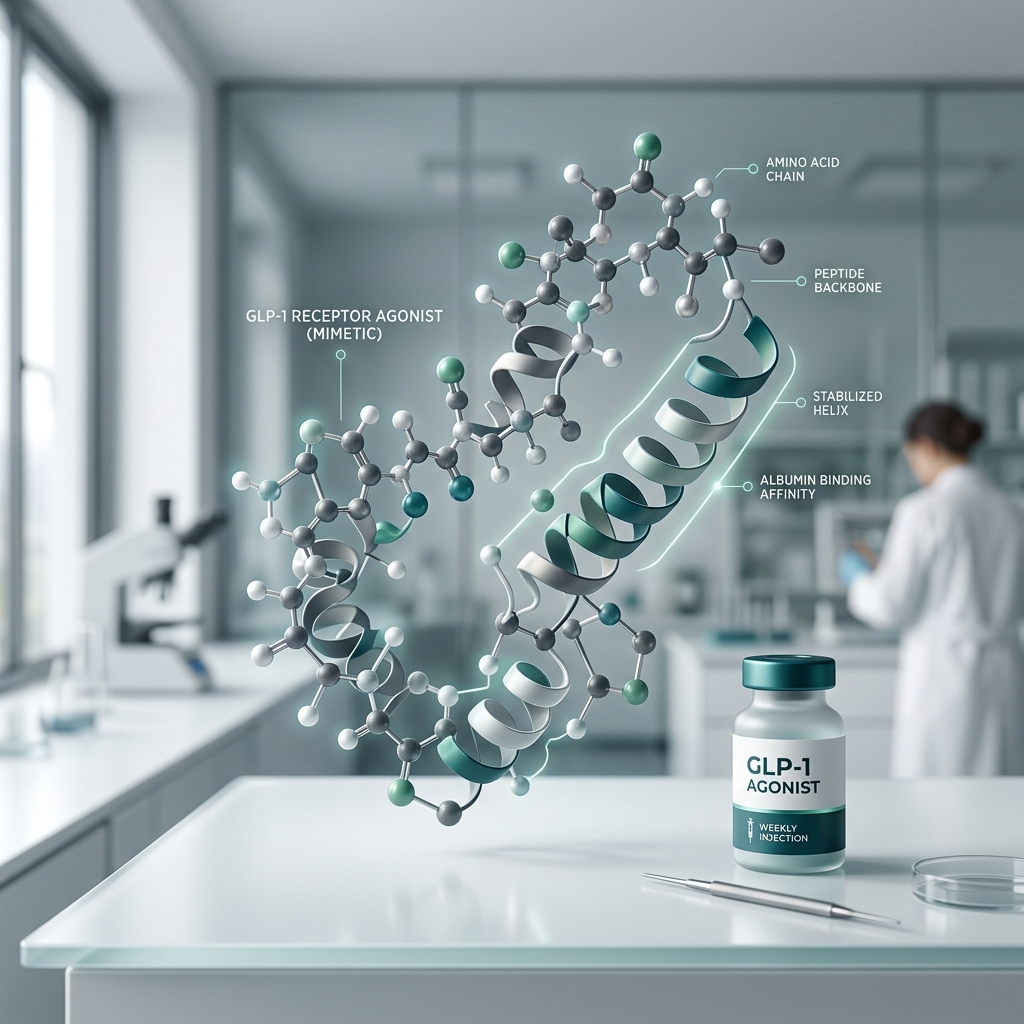
A GLP-1 medication (like Semaglutide) is a synthetically engineered version of this hormone. Scientists altered the amino acid structure just enough so that the DPP-4 enzyme cannot destroy it. Instead of lasting 2 minutes, a Semaglutide injection lasts for 165 hours (roughly 7 days). The "I'm full" signal is permanently switched on.
How Do GLP-1 Medications Cause Weight Loss?
While originally developed to lower A1C in Type 2 Diabetics, endocrinologists quickly realized that GLP-1s cause massive, sustained weight loss through three distinct mechanisms.
1. Neurological Satiety (Crushing "food noise")
The most profound effect of a GLP-1 medication is psychological. Patients report that the constant, obsessive thoughts about food—what the medical community calls "food noise"—completely disappear. The drug acts directly on the brain's reward centers. You no longer crave high-sugar, high-fat foods. You eat a few bites and feel physically and mentally satisfied.
2. Delayed Gastric Emptying
GLP-1 receptors in the gastrointestinal tract physically slow down the rate at which your stomach empties food into your small intestine. A meal that would normally digest in two hours might take four or six hours. Because there is literally still food in your stomach, you remain physically full for the entire day. (Note: this is also the primary mechanism behind the nausea side effect).
3. Reversing Insulin Resistance
As we detailed in our guide on Ozempic for insulin resistance, by enforcing a caloric deficit and reducing visceral fat, the cells regain their sensitivity to insulin. The biological "lock" on fat storage is removed, allowing the body to easily burn stored visceral fat for energy.
Semaglutide vs Tirzepatide: The Heavyweights
Currently, the market is dominated by two massive players. Understanding the difference between them is critical for selecting the right therapy.
| Feature | Semaglutide (Ozempic/Wegovy) | Tirzepatide (Mounjaro/Zepbound) |
|---|---|---|
| Mechanism | Single Agonist (GLP-1 only) | Dual Agonist (GLP-1 + GIP) |
| Average Weight Loss | 15% of body weight (STEP 1 Trial) | 20.9% to 22.5% of body weight (SURMOUNT-1) |
| Side Effect Profile | Moderate (Nausea, constipation) | Potentially lower nausea (GIP mitigates GLP-1 side effects) |
| Best For | First-line treatment, standard obesity | Treatment-resistant obesity, severe insulin resistance |
While Semaglutide is the most famous, Tirzepatide represents the next generation of metabolic drugs. By adding GIP (Glucose-Dependent Insulinotropic Polypeptide) to the molecule, Tirzepatide achieves even greater fat loss while theoretically buffering some of the intense nausea associated with pure GLP-1s.
Content Gap: The Truth About Affordability and Access
Major medical sites like WebMD will explain what a GLP-1 medication is, but they will not tell you how to afford it. The pharmaceutical companies price Wegovy at roughly $1,349 per month and Zepbound at $1,059 per month. If your insurance denies your claim because you don't perfectly meet the Wegovy FDA label criteria, you are expected to pay out of pocket.
The Compounding Pharmacy Solution
Because Novo Nordisk and Eli Lilly cannot manufacture these drugs fast enough, both Semaglutide and Tirzepatide are currently on the FDA Drug Shortage List. Under federal law, this allows licensed 503A and 503B compounding pharmacies to produce the exact same active pharmaceutical ingredient.
Telehealth platforms like Telehealth FX connect patients with board-certified clinicians who can prescribe these compounded medications off-label. This bypasses the insurance monopoly and brings the cost down to as low as $146 per month for Semaglutide. It is the exact same clinical molecule, shipped directly to your door in sterile vials, for a fraction of the cost.
Get Started With Compounded GLP-1s
Take our 60-second medical assessment to see if you qualify for affordable, clinical-grade Semaglutide or Tirzepatide.
Check EligibilityFrequently Asked Questions (FAQ)
Are GLP-1 medications safe?
Yes, they have been rigorously tested. Semaglutide has been on the market for Type 2 Diabetes since 2017. However, they are serious medical interventions. They carry a black box warning for Thyroid C-cell Tumors (in rodents) and are contraindicated for anyone with a history of Medullary Thyroid Carcinoma.
Will I lose muscle mass?
Any rapid weight loss will result in some lean tissue loss. Because GLP-1s suppress your appetite so severely, it is critical that you prioritize high-protein meals and engage in resistance training to preserve your muscle mass while the drug melts away the visceral fat.
What happens if I stop taking it?
GLP-1 medications do not permanently change your DNA. If you use the drug to lose 50 pounds, but fail to change your underlying relationship with food, the "food noise" will return when you stop the medication, and you will likely regain the weight. It is a powerful tool to enforce a deficit while you build permanent, healthy habits.
Is Berberine really "Nature's Ozempic"?
No. Berberine works via AMPK activation, not the GLP-1 receptor. It does not crush your appetite or slow gastric emptying. It is a phenomenal supplement for mild insulin resistance, but it is not in the same universe as Semaglutide. We compare them directly in our Berberine vs Ozempic clinical guide.
Ready to Fix Your Metabolism?
Stop fighting your biology. Get a medical evaluation for compounded GLP-1 therapy today and start reversing insulin resistance at the cellular level.
Start Your EvaluationAcademic References & Clinical Citations
- Nauck, M. A., Quast, D. R., Wefers, J., & Meier, J. J. (2021). GLP-1 receptor agonists in the treatment of type 2 diabetes – state-of-the-art. Molecular Metabolism, 46, 101102. https://pubmed.ncbi.nlm.nih.gov/33068776/
- Wilding, J. P. H., Batterham, R. L., Calanna, S., Davies, M., Van Gaal, L. F., Lingvay, I., McGowan, B. M., Rosenstock, J., Tran, M. T. D., Wadden, T. A., Wharton, S., Yokote, K., Zeuthen, N., & Kushner, R. F. (2021). Once-Weekly Semaglutide in Adults with Overweight or Obesity (STEP 1). The New England Journal of Medicine, 384(11), 989–1002. https://doi.org/10.1056/NEJMoa2032183
- Jastreboff, A. M., Aronne, L. J., Ahmad, N. N., Wharton, S., Connery, L., Alves, B., Kiyosue, A., Zhang, S., Liu, B., Bunck, M. C., & Stefanski, A. (2022). Tirzepatide Once Weekly for the Treatment of Obesity (SURMOUNT-1). The New England Journal of Medicine, 387(3), 205–216. https://doi.org/10.1056/NEJMoa2206038