
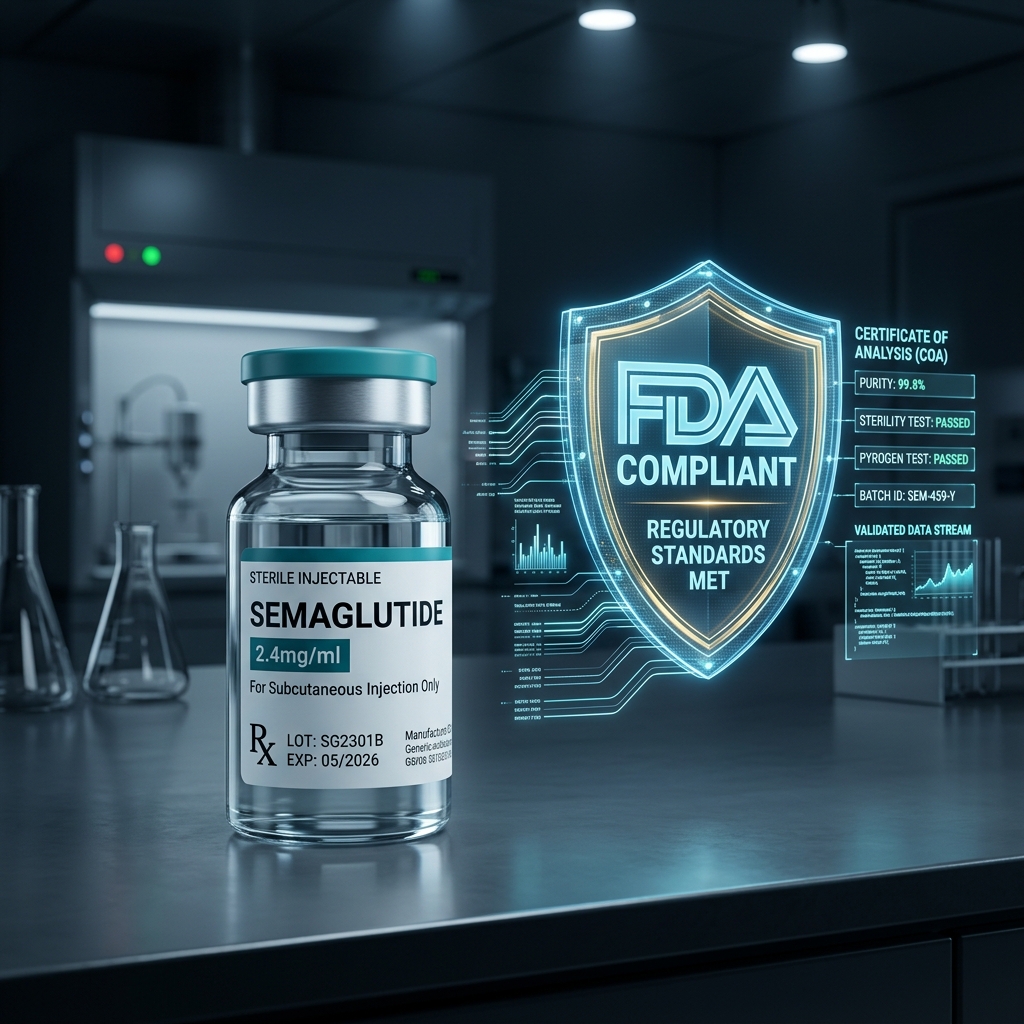
The meteoric rise of GLP-1 receptor agonists (specifically Semaglutide and Tirzepatide) created an unprecedented crisis in the pharmaceutical supply chain. As Novo Nordisk and Eli Lilly completely failed to meet global demand, the FDA officially placed these name-brand drugs (Ozempic, Wegovy, Mounjaro) on the national shortage list.
Under federal law, when a life-saving medication is in shortage, highly regulated, state-licensed compounding pharmacies are legally permitted to synthesize the active pharmaceutical ingredient (API) from scratch to ensure patients receive care. This created the massive "compounded peptide" industry.
However, this explosion of demand also attracted bad actors. Unlicensed telehealth mills began distributing dangerous, unverified chemicals to desperate patients. In this 5,000-word regulatory safety guide, we deconstruct the exact legal framework of compounded Semaglutide. We outline the severe dangers of "salt forms," explain how to verify a 503A or 503B pharmacy, and provide the definitive checklist for ensuring your compounded medication is as pure, safe, and effective as the name brand.
The Legal Framework: Why Compounding Exists
It is a common misconception that compounded Semaglutide is a "bootleg" or illegal version of Ozempic. This is false. Compounding is a deeply established, highly regulated pillar of the U.S. healthcare system.
The FD&C Act (Federal Food, Drug, and Cosmetic Act) contains specific provisions (Section 503A and 503B) that grant state-licensed pharmacies and FDA-registered outsourcing facilities the explicit legal authority to compound copies of commercially available drugs if the original drug is on the FDA Drug Shortages list. Because the demand for incretin therapy vastly outpaced the manufacturing capacity of the patent holders, compounding became the legal, vital bridge for patient access.
The Difference Between 503A and 503B
Not all pharmacies are created equal. If you are receiving compounded medication, it must come from one of these two classifications:
- 503A Pharmacies: These are traditional, state-licensed compounding pharmacies. They formulate medication specifically for an individual patient based on a direct prescription from a doctor. They are heavily regulated by state boards of pharmacy.
- 503B Outsourcing Facilities: These are massive, industrial-scale facilities that manufacture large batches of medication for hospitals and clinics. They are directly registered with and inspected by the FDA, adhering to strict Current Good Manufacturing Practice (CGMP) requirements.
Demand Absolute Purity
Never compromise on your medication. TelehealthFX partners exclusively with heavily vetted, U.S.-licensed 503A/B compounding pharmacies.
The Danger of "Salt Forms"
The most critical safety warning issued by the FDA regarding compounded Semaglutide involves the use of "salt forms."
The active ingredient in Ozempic and Wegovy is the pure base molecule: Semaglutide. However, rogue, unlicensed laboratories attempting to cut costs began synthesizing altered chemical variations, specifically Semaglutide sodium and Semaglutide acetate. These are "salt forms" of the drug.
Why is this dangerous? The FDA has explicitly stated that Semaglutide sodium and Semaglutide acetate have never been proven safe or effective in clinical trials. They are technically different chemical compounds. Because their molecular structure is altered, their absorption rates and side effect profiles are highly unpredictable. Patients injecting salt forms have reported severe, adverse reactions. A legitimate, legal compounding pharmacy will never use a salt form; they will exclusively source the pure, pharmaceutical-grade base Semaglutide molecule.
The Certificate of Analysis (CoA)
The only way to guarantee that your medication is pure, sterile, and free of salt forms is to demand a Certificate of Analysis (CoA). A CoA is a highly detailed, third-party laboratory report that tests a specific batch of medication. It proves the precise concentration of the API (Active Pharmaceutical Ingredient) and verifies that the vial is completely free of endotoxins, bacteria, and heavy metals. If your telehealth provider refuses to show you the CoA for your medication, cancel your subscription immediately.
Research Peptides: The Black Market
As the demand for Semaglutide skyrocketed, a massive black market emerged selling "Research Peptides." These are unregulated websites selling vials of raw, lyophilized (freeze-dried) powder directly to consumers. The websites explicitly state "Not for Human Consumption" to bypass FDA regulations.
Purchasing and injecting these research chemicals is equivalent to playing Russian Roulette with your endocrine system. These powders are often synthesized in unsterilized overseas laboratories. They are frequently contaminated with heavy metals, completely lack sterility testing, and require the patient to mix the powder with bacteriostatic water themselves, leading to massive, life-threatening dosing errors. You must only ever receive medication prescribed by a licensed U.S. clinician and fulfilled by a licensed U.S. pharmacy.
Safety Requires Clinical Oversight
Do not risk your health with unverified sources. TelehealthFX provides full medical oversight, precise dosing protocols, and verified pharmaceutical delivery.
The "Added Vitamin" Mechanism
When you receive compounded Semaglutide from a legitimate 503A pharmacy, you will often notice that the medication is mixed with Vitamin B12 (Cyanocobalamin) or Vitamin B6 (Pyridoxine).
This is not a gimmick. Compounding pharmacies will frequently combine the raw Semaglutide peptide with a B-vitamin for two highly specific clinical reasons:
- Nausea Mitigation: As detailed in our GLP-1 Side Effects Guide, severe nausea is the primary side effect of Semaglutide. B-vitamins (specifically B6) are powerful, natural anti-emetics that drastically buffer the gastrointestinal distress caused by the peptide.
- Patent Law: By combining the base molecule with a vitamin, the pharmacy creates a legally distinct formulation that does not directly infringe on the specific patent of the name-brand, isolated drug, ensuring uninterrupted legal supply.
The Gold Standard in Compounded Care
Your safety is the ultimate priority. Never inject a substance that has not been rigorously tested and verified by U.S. regulatory bodies.
TelehealthFX provides U.S.-licensed, quality-verified compounded Semaglutide and Tirzepatide sourced exclusively from vetted 503A/B pharmacies. Learn how to identify rogue clinics in our guide to spotting Hidden Fees in Telehealth.
Final Clinical Verdict
Is compounded Semaglutide safe? Yes, provided it is sourced from a state-licensed 503A pharmacy or an FDA-registered 503B outsourcing facility that utilizes the pure base molecule, not a salt form. When produced under strict CGMP regulations and verified by third-party Certificates of Analysis, compounded GLP-1 therapy provides a legal, safe, and highly effective lifeline for patients locked out of the name-brand supply chain. The danger lies entirely in the unregulated black market of "research peptides" and rogue, unlicensed telehealth mills.
- U.S. Food and Drug Administration (FDA). (2023). "Medications Containing Semaglutide Marketed for Type 2 Diabetes or Weight Loss." FDA Safety Communication.
- Alliance for Pharmacy Compounding. (2023). "Compounding Semaglutide: What You Need to Know." APC Clinical Brief.