
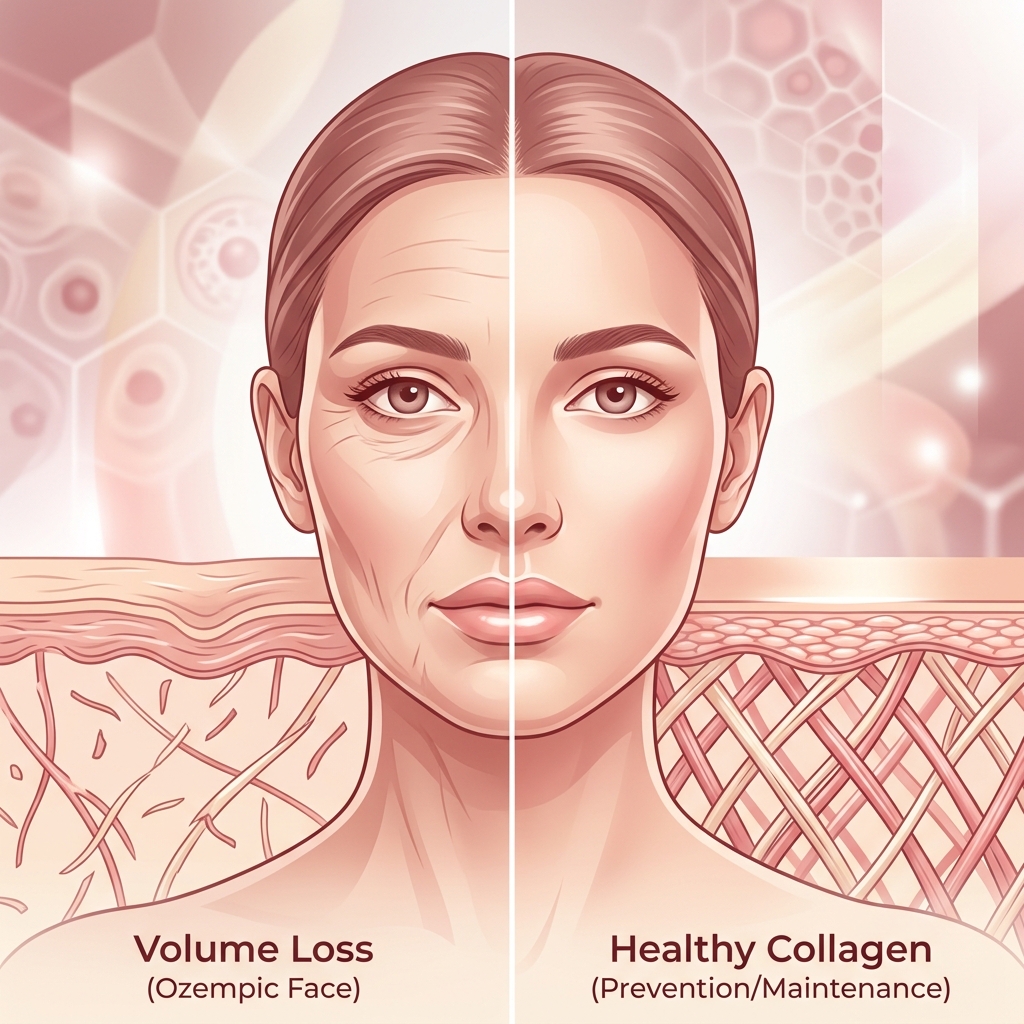
"Ozempic Face" has become the most recognizable aesthetic consequence of rapid GLP-1 weight loss. The term — coined by dermatologists in 2023 — describes the gaunt, hollow, prematurely aged facial appearance that occurs when significant fat is lost from the buccal fat pads, nasolabial folds, and periorbital region simultaneously. The result is sagging skin, deepened wrinkles, and a deflated appearance that can add 5–15 years to your facial age.
The phenomenon is not unique to semaglutide — it occurs with any significant weight loss method (bariatric surgery, extreme diets, or any GLP-1). But because semaglutide produces 15–22% weight loss in a relatively short timeframe, the facial volume loss can be dramatic and sudden. The good news: Ozempic Face is largely preventable with proactive measures, and treatable if it occurs.
Why Rapid Weight Loss Ages Your Face: The Biology
Your face is supported by three structural layers: bone, fat, and skin. Weight loss attacks two of them simultaneously. First, subcutaneous facial fat — the buccal fat pads, malar fat, and periorbital fat that give your face its youthful volume — is lost alongside body fat. Unlike visceral abdominal fat (which is metabolically active and preferentially lost first), facial fat loss is often disproportionate to total weight loss because the face has a high surface-area-to-volume ratio.
Second, rapid weight loss impairs collagen synthesis. Collagen production requires adequate protein intake and specific amino acids (glycine, proline, hydroxyproline). GLP-1 patients who are not meeting protein targets experience accelerated collagen degradation — visible as skin laxity, fine lines, and loss of elasticity. The face, which has thinner skin than most body regions, shows these changes first and most dramatically.
Third, dehydration (common on GLP-1 therapy) further depletes facial volume. Hyaluronic acid — the molecule that keeps skin plump and hydrated — depends on adequate water intake. Chronic mild dehydration, combined with reduced food intake, creates a skin environment that accelerates visible aging.
Risk Factors: Who Gets Ozempic Face?
| Risk Factor | Why It Matters | Risk Level |
|---|---|---|
| Age over 40 | Collagen production declines 1% per year after 30 | High |
| Rapid weight loss (>2 lbs/week) | Skin cannot remodel fast enough | High |
| Total weight loss >15% | Greater proportional facial fat depletion | Moderate–High |
| Low protein intake | Insufficient collagen synthesis substrates | High |
| Sun damage history | Pre-existing collagen degradation compounds effects | Moderate |
| Smoking (current/former) | Impaired microcirculation and collagen synthesis | High |
Patients over 40 with high total weight loss are at the greatest risk. If you are in this category, the prevention protocol below is not optional — it is essential. Women over 40 face additional risk because estrogen decline during perimenopause further accelerates collagen loss. Men over 50 also experience significant facial volume changes, though the cultural visibility is often lower.
The 8-Step Ozempic Face Prevention Protocol
1. Hit Your Protein Target — No Exceptions
1.0–1.2g protein per pound of target body weight, daily. This provides the amino acids (glycine, proline, lysine) required for collagen synthesis while also preserving lean muscle mass. Collagen-specific protein sources (bone broth, gelatin, collagen peptides) are particularly effective. See our food guide.
2. Collagen Supplementation (10–15g Daily)
Hydrolyzed collagen peptides (Type I and III) provide the specific amino acid profile needed for skin elasticity. Multiple randomized controlled trials demonstrate improved skin hydration and elasticity with 8–12 weeks of supplementation at 10g/day. Take with Vitamin C (which is required as a cofactor for collagen synthesis).
3. Aggressive Hydration
80–100oz water daily. Hyaluronic acid in your skin holds 1,000x its weight in water — but only if water is available. Chronic dehydration (extremely common on GLP-1 due to reduced thirst signals) directly causes facial volume loss and skin dullness.
4. Sunscreen — Daily, Non-Negotiable
UV exposure is the #1 external cause of collagen degradation (photoaging). SPF 30+ broad-spectrum sunscreen every day, even indoors if you sit near windows. This prevents additional collagen loss on top of the weight-loss-related changes.
5. Retinoid (Tretinoin or Retinol) at Night
Retinoids are the gold-standard topical for stimulating collagen synthesis and increasing skin cell turnover. Start with 0.025% tretinoin or an OTC retinol serum. Apply at night (retinoids degrade in sunlight). Build tolerance gradually — every other night for 4 weeks, then nightly.
6. Moderate Your Rate of Weight Loss
Target 1–2 lbs per week, not 3–4. Slower weight loss gives skin more time to remodel. If you are losing faster, discuss dose adjustment with your clinician. The plateau protocol paradoxically helps here — periodic slowdowns allow skin adaptation.
7. Resistance Training for Facial Support
While you cannot "spot train" your face, full-body resistance training preserves the muscular support structure beneath facial skin. Strong neck, jaw, and upper back muscles provide mechanical support that reduces sagging. The exercise protocol already recommended for GLP-1 patients provides this benefit.
8. Omega-3 and Vitamin C Supplementation
Omega-3 fatty acids (EPA/DHA) reduce systemic inflammation that accelerates collagen breakdown. Vitamin C (500–1000mg daily) is the essential cofactor for collagen synthesis — without adequate Vitamin C, your body literally cannot build collagen regardless of how much protein you consume.
Your TelehealthFX Protocol Includes Body Composition Guidance
Clinician-guided dose titration to optimize weight loss rate. From $199/month. HSA/FSA accepted.
Start Your EvaluationTreatment Options If Ozempic Face Has Already Occurred
If facial volume loss has already occurred, several evidence-based treatment options exist. These are cosmetic procedures — not covered by insurance — but can dramatically restore facial volume:
- Hyaluronic acid fillers (Juvederm, Restylane): The most common treatment. Injected into hollowed cheeks, nasolabial folds, and under-eye areas. Results last 12–18 months. Cost: $600–$1,200 per syringe.
- Sculptra (poly-L-lactic acid): Stimulates natural collagen production rather than filling. Gradual results over 3–6 months, lasting 2+ years. Preferred for diffuse volume loss. Cost: $800–$1,500 per session.
- Microneedling with PRP: Creates controlled micro-injuries that stimulate collagen remodeling. Requires 3–6 sessions. Cost: $300–$700 per session.
- Radiofrequency skin tightening (Morpheus8, Thermage): Non-surgical skin tightening using heat energy to remodel collagen. Results develop over 3–6 months. Cost: $1,000–$3,000 per session.
Important: wait until your weight has stabilized (typically 12–18 months into GLP-1 therapy) before pursuing filler treatments. If you inject fillers while still actively losing weight, the volume loss will continue and the results will be short-lived. See our comprehensive loose skin guide for full-body treatment options.
Frequently Asked Questions
Does everyone get Ozempic Face?
No. Facial volume loss correlates strongly with total weight loss, age, and protein intake. Patients who lose less than 10% of body weight rarely experience significant facial changes. Those who follow the 8-step prevention protocol dramatically reduce their risk even at higher weight loss levels.
Is Ozempic Face reversible?
Partially. Collagen can be rebuilt with proper nutrition, topical retinoids, and professional treatments. Lost buccal fat does not return without weight regain, but fillers can restore volume. Starting the prevention protocol early is far more effective than treating after the fact.
Is Ozempic Face worse with semaglutide or tirzepatide?
Tirzepatide produces greater total weight loss (up to 22.5% in SURMOUNT trials), which means proportionally greater facial volume loss risk. The prevention protocol is equally important regardless of which GLP-1 you use.
Clinician-Guided Weight Loss. Aesthetic Support. From $199/mo.
Dose optimization to control your rate of loss. Tirzepatide from $349/mo.
Get StartedReferences
- Pessa, J. E. (2000). An algorithm of facial aging: verification of Lambros' theory by 3D morphometry. Plastic and Reconstructive Surgery, 106(2), 479–488.
- Proksch, E., et al. (2014). Oral supplementation of specific collagen peptides has beneficial effects on human skin physiology. Skin Pharmacology and Physiology, 27(1), 47–55.
- Varani, J., et al. (2006). Decreased collagen production in chronologically aged skin. American Journal of Pathology, 168(6), 1861–1868.
- Wilding, J. P. H., et al. (2021). STEP 1 Trial. NEJM, 384(11), 989–1002.