
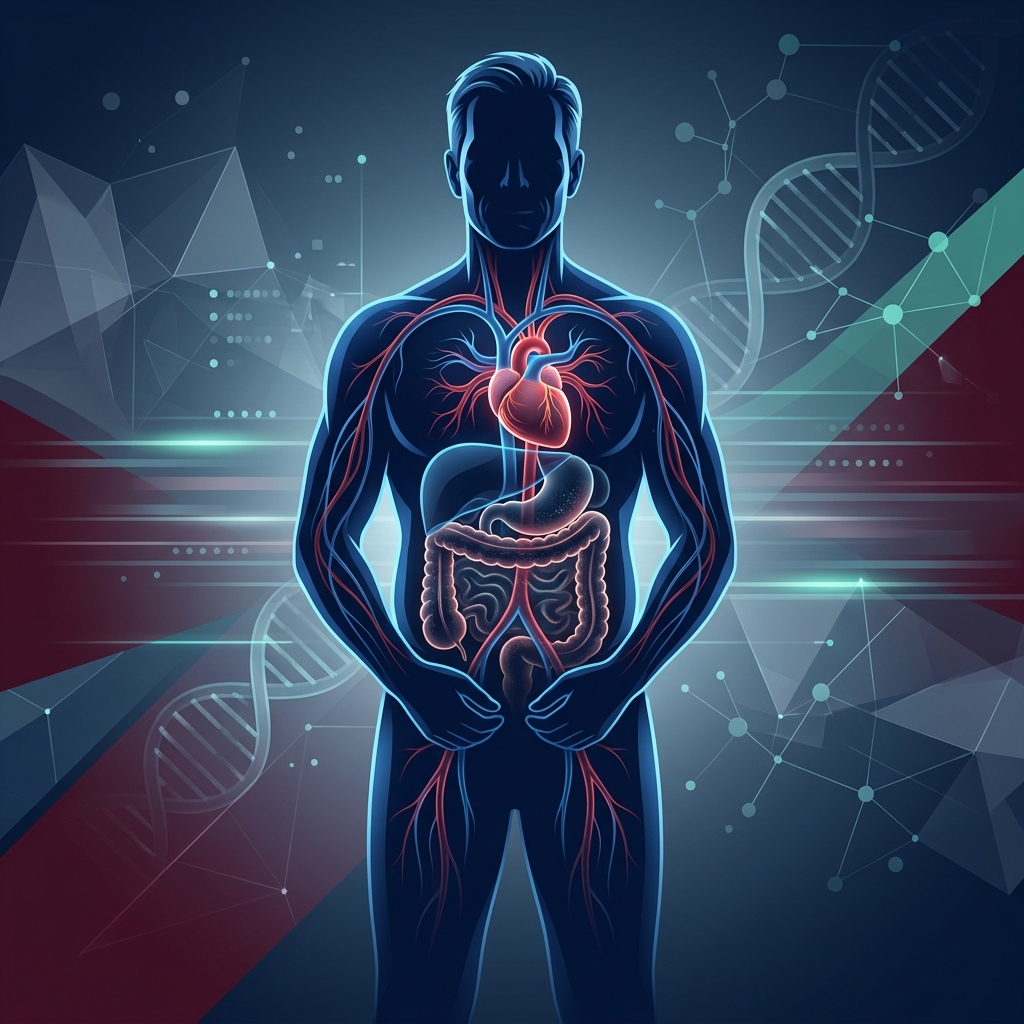
Men over 50 face a vicious metabolic cycle: visceral fat accumulates around the organs, visceral fat converts testosterone to estrogen via aromatase enzyme, low testosterone promotes more fat storage and muscle loss, and the cycle accelerates. Meanwhile, cardiovascular disease risk climbs sharply — heart attack is the #1 killer of men in this age group. GLP-1 therapy breaks this cycle at the metabolic root by preferentially reducing visceral fat, improving insulin sensitivity, and delivering proven cardiovascular protection.
The Visceral Fat–Testosterone Cascade
| Problem | Mechanism | Consequence for Men 50+ | GLP-1 Effect |
|---|---|---|---|
| Visceral fat accumulation | Insulin resistance + cortisol | CVD risk, NAFLD, diabetes | Preferential reduction |
| Testosterone decline | Aromatase in fat tissue | Fatigue, muscle loss, mood | Indirect — via fat loss |
| Cardiovascular risk | Atherosclerosis + inflammation | #1 cause of death in men | 20% MACE reduction |
| Sleep apnea | Neck/visceral fat compression | Fatigue, CVD amplifier | 63% AHI reduction |
| Joint degeneration | Mechanical + inflammatory | Mobility loss, inactivity | Weight unloading + anti-inflammatory |
GLP-1 and Testosterone: What the Data Shows
Visceral fat contains high concentrations of aromatase — the enzyme that converts testosterone to estradiol (estrogen). The more visceral fat a man carries, the lower his free testosterone and the higher his estrogen levels. This creates a hormonal profile that promotes even more fat storage: a self-reinforcing spiral.
GLP-1's preferential reduction of visceral fat directly reduces aromatase activity. Studies show that men who lose 10–15% of body weight via GLP-1 see testosterone increase by 50–100 ng/dL on average — enough to move many men from the hypogonadal range back into normal territory without testosterone replacement therapy. This testosterone recovery improves energy, mood, libido, and capacity for exercise — which further accelerates fat loss and muscle preservation.
Cardiovascular Protection: The SELECT Trial for Men
The SELECT trial enrolled 17,604 patients with established cardiovascular disease or high risk — the exact profile of many men over 50. Semaglutide 2.4mg reduced major adverse cardiovascular events by 20%:
- Heart attack: 28% reduction in non-fatal MI
- Stroke: 7% reduction (trending significant)
- Cardiovascular death: 15% reduction
For men over 50 with existing risk factors (hypertension, elevated lipids, visceral obesity), GLP-1 is not just a weight loss drug — it is a longevity intervention that directly reduces the #1 cause of death.
Lose the Gut. Protect Your Heart. Reclaim Your Energy.
Compounded semaglutide from $199/month. Clinician-guided. HSA/FSA accepted.
Start Your EvaluationThe Multi-Organ Protection Profile for Men 50+
GLP-1 addresses virtually every organ system affected by male metabolic aging:
- Heart: 20% MACE reduction. Blood pressure drops 5–8 mmHg.
- Liver: 59% MASH resolution. NAFLD affects 40%+ of men over 50.
- Kidneys: 24% reduction in kidney events. CKD is common in diabetic and hypertensive men.
- Joints: Dramatic mobility improvement. Knee and back pain from decades of carrying excess weight.
- Sleep: 63% reduction in sleep apnea severity. OSA affects ~25% of men over 50.
- Metabolic markers: All 5 metabolic syndrome criteria improve simultaneously.
Muscle Preservation: The Critical Concern for Older Men
Men over 50 are already losing muscle mass at 1–2% per year (sarcopenia). Adding GLP-1-induced weight loss without a proper resistance training protocol risks accelerating muscle loss. This is the single biggest risk of GLP-1 therapy for older men — and it is entirely preventable:
- Protein intake: Minimum 1g per pound of target body weight. See our food guide.
- Resistance training: 2–3 sessions per week. Focus on compound movements. See our exercise protocol.
- Muscle monitoring: Our muscle preservation guide details the complete protocol. For seniors, also see our weight loss after 60 guide.
Frequently Asked Questions
Will GLP-1 increase my testosterone?
Indirectly, yes. Weight loss — especially visceral fat loss — reduces aromatase activity and typically increases total and free testosterone by 50–100 ng/dL. This is a natural hormonal recovery, not exogenous testosterone.
Is GLP-1 safe if I have a history of heart disease?
Not only is it safe — it is specifically beneficial. The SELECT trial enrolled patients with established cardiovascular disease and showed a 20% reduction in major cardiac events. Discuss with your cardiologist, but the data strongly supports GLP-1 in this population.
Should I choose semaglutide or tirzepatide?
If cardiovascular protection is the primary goal, semaglutide has the stronger outcome data (SELECT trial). If maximum weight loss is the priority, tirzepatide produces 22.5% vs. 14.9%. Many men start with semaglutide for the cardiovascular benefit and cost advantage ($199 vs. $349/month). See our decision guide.
Break the Cycle. Protect Your Heart. One Injection Per Week.
Compounded semaglutide from $199/mo. Tirzepatide from $349/mo. Clinician-guided. No insurance required.
Get StartedReferences
- Lincoff, A. M., et al. (2023). Semaglutide and cardiovascular outcomes in obesity (SELECT). NEJM, 389(24), 2221–2232.
- Corona, G., et al. (2015). Body weight loss reverts obesity-associated hypogonadotropic hypogonadism. JCEM, 98(7), 3007–3014.
- Dhindsa, S., et al. (2018). Testosterone in males with obesity. Endocrinology and Metabolism Clinics, 47(1), 229–245.