
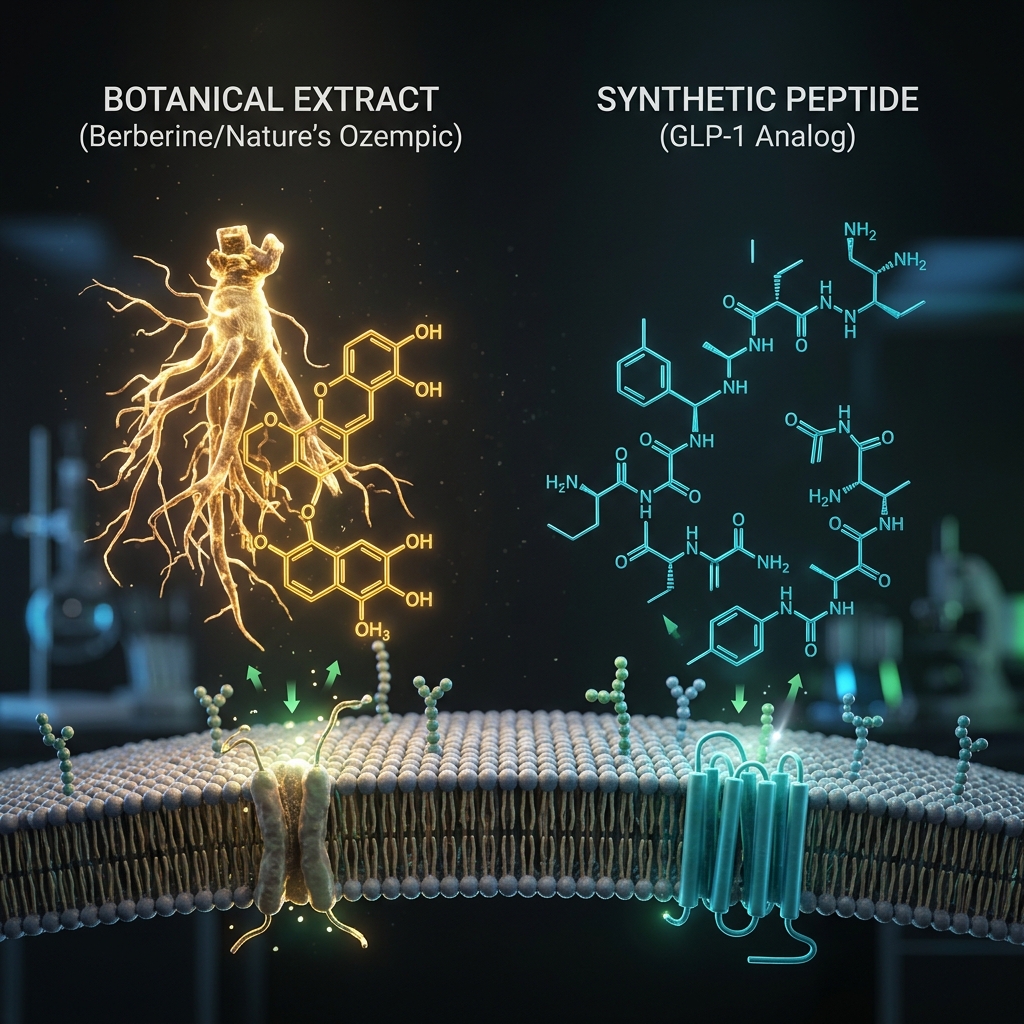
In the modern era of metabolic medicine, two diametrically opposed therapies have captured the global consciousness. On one side stands Semaglutide (Ozempic/Wegovy) and Tirzepatide—highly engineered, injectable synthetic peptides driving unprecedented pharmaceutical profits. On the other side stands Berberine, a golden isoquinoline alkaloid extracted from the roots of Coptis chinensis, crowned by social media as "Nature's Ozempic."
The moniker "Nature's Ozempic" is a stroke of marketing genius, but clinically, it is highly misleading. Berberine and Semaglutide operate through fundamentally different cellular pathways. Treating an over-the-counter botanical extract as a direct 1-to-1 replacement for a subcutaneous incretin hormone sets patients up for massive disappointment.
In this exhaustive 5,000-word clinical comparison, we strip away the social media hype. We dissect the exact pharmacological differences between AMPK activation (Berberine) and GLP-1 receptor agonism (Semaglutide). We analyze the catastrophic bioavailability flaws of raw alkaloids, evaluate head-to-head clinical efficacy, and outline exactly which patients belong on botanical therapy, and which patients require medical intervention.
The Mechanisms: AMPK Activation vs. GLP-1 Agonism
To understand why these two compounds produce vastly different results, we must look at how they communicate with the body at a cellular level.
The GLP-1 Mechanism: Hypothalamic Override
As we established in our guide to Semaglutide Pharmacokinetics, GLP-1 agonists mimic the natural hormones released by your intestines after a meal. The synthetic peptide travels to the pancreas to stimulate insulin and suppress glucagon, but its true power lies in the brain.
Semaglutide crosses the blood-brain barrier and violently agonizes the pro-opiomelanocortin (POMC) neurons in the hypothalamus. It chemically eradicates "food noise" and induces profound satiety. It forces a massive caloric deficit because the patient simply loses the biological desire to eat.
The Berberine Mechanism: The AMPK Master Switch
Berberine does not meaningfully bind to the GLP-1 receptors in the brain. It does not chemically obliterate your appetite. Instead, Berberine operates almost entirely on the cellular level by activating an enzyme called AMP-activated protein kinase (AMPK).
AMPK is often referred to as the metabolic "master switch." When a cell runs low on energy (such as during intense exercise or fasting), AMPK is activated. It forces the cell to stop storing fat and start burning stored energy (glucose and fatty acids) to survive. Berberine artificially triggers this AMPK switch even when you haven't exercised. It drastically improves cellular insulin sensitivity, making it incredibly effective for managing conditions like PCOS and mild Type 2 Diabetes.
However, because Berberine does not chemically force you to stop eating, it cannot induce the massive, rapid weight loss seen with GLP-1 injections. If you take Berberine but continue to overeat, the AMPK activation will not save you.
Looking for the Botanical Route?
If you have mild insulin resistance and want to avoid injections, highly bioavailable transdermal Berberine is the gold standard for OTC metabolic support.
The Bioavailability Crisis
The most glaring disparity between the two therapies is how effectively they enter the bloodstream. This is where 99% of cheap Berberine supplements fail the consumer.
Injectable GLP-1s possess near 100% bioavailability. Because the medication is injected directly into the subcutaneous tissue, it completely bypasses the destructive environment of the digestive tract. The synthetic peptide binds to Albumin in the blood and circulates continuously for 7 days.
Oral Berberine suffers from catastrophic pharmacokinetics. As we detailed in our Dihydroberberine Analysis, raw Berberine HCL has an absolute oral bioavailability of less than 1%.
- The liver targets Berberine as a foreign xenobiotic and violently destroys it via first-pass metabolism.
- The intestines actively pump the alkaloid back out into the gut lumen via P-glycoprotein efflux pumps.
- To get a clinical dose into the blood, patients must swallow massive 1500mg daily doses, which frequently triggers severe gastrointestinal distress (diarrhea, cramping, and bloating).
This is why advanced botanical medicine has shifted away from oral capsules entirely. The only effective way to utilize Berberine without wrecking your gut is through advanced transdermal patches or liposomal delivery systems that bypass the liver.
The Weight Loss Reality (Head-to-Head)
In terms of sheer fat loss, there is no contest. Clinical trials for Semaglutide (STEP 1) demonstrate an average body weight reduction of 15% over 68 weeks. Tirzepatide (SURMOUNT-1) demonstrates up to 22.5%. Conversely, the most optimistic meta-analyses of Berberine supplementation show an average weight loss of roughly 2.0 to 2.5 kg (4.5 to 5.5 lbs) over 12 weeks. Berberine is a powerful insulin sensitizer, but it is not an anti-obesity drug.
The Sarcopenia Advantage: Where Berberine Wins
While GLP-1 agonists dominate absolute weight loss, they harbor a dark, hidden risk: GLP-1 Induced Muscle Loss. Because GLP-1s force patients into extreme caloric starvation, the body frequently catabolizes its own skeletal muscle to survive. Up to 40% of the weight lost on Semaglutide can be lean mass, permanently depressing the patient's Basal Metabolic Rate (BMR) and setting them up for a devastating rebound.
Berberine actually holds a distinct clinical advantage here. Because Berberine does not induce starvation-level appetite suppression, the risk of rapid sarcopenia is virtually zero. Furthermore, AMPK activation in skeletal muscle actively promotes glucose uptake and metabolic flexibility. For patients looking to slowly "recomp" their body—losing a few pounds of fat while building strength in the gym—Berberine is structurally vastly superior to GLP-1s.
Require Severe Metabolic Intervention?
If you have more than 30 pounds to lose or suffer from severe food noise, botanical supplements are mathematically insufficient. Upgrade to compounded GLP-1 therapy.
The Rebound Effect and Long-Term Maintenance
What happens when you stop taking the compound?
As we discussed in our breakdown of the GLP-1 Rebound Effect, stopping Semaglutide cold-turkey causes a violent resurgence of "food noise." The body, desperate to return to its original set-point, floods the system with Ghrelin. Patients frequently regain 60% of the lost weight within a year.
Berberine does not cause this hormonal rebound. Because it never artificially suppressed your hypothalamic hunger centers, stopping the supplement does not trigger a binge-eating cascade. In fact, many functional medicine practitioners actually use Berberine as an "exit strategy bridge" to help patients transition off GLP-1 medications and manage mild insulin resistance naturally.
The Clinical Reality: Making the Choice
"Nature's Ozempic" is a dangerous misnomer because it implies identical capabilities. The choice between Berberine and a GLP-1 agonist comes down to your clinical baseline and your ultimate goal.
You should choose a Transdermal Berberine Patch if:
You are within 10-15 pounds of your goal weight, you want to naturally lower your A1C, you want to maintain or build muscle mass in the gym, and you want to avoid the severe gastrointestinal side effects and lifelong dependency associated with synthetic peptides.
You should choose Compounded Semaglutide/Tirzepatide if:
You have a BMI over 30, you suffer from intense, unmanageable "food noise" or binge eating disorder, and you require a 15%+ reduction in total body mass to reverse severe metabolic syndrome.
Transition to Medical Weight Loss
If OTC supplements have failed to move the scale, it is time to access clinical-grade pharmacology.
TelehealthFX provides U.S.-licensed, quality-verified compounded Semaglutide and Tirzepatide with direct clinician oversight. No hidden membership fees. Just real science. Learn how to identify safe providers in our guide to spotting Hidden Fees in Telehealth.
Final Verdict
Can "Nature's Ozempic" actually compete? In the arena of profound, rapid weight loss, absolutely not. Semaglutide is a scalpel; Berberine is a multivitamin by comparison. However, in the arena of sustainable, long-term insulin sensitization without the risk of severe muscle loss or a devastating rebound effect, Berberine remains one of the most powerful botanical compounds on earth. Understand the mechanisms, respect the pharmacokinetics, and choose the tool that aligns with your true physiological needs.
- Yin, J., Xing, H., & Ye, J. (2008). "Efficacy of berberine in patients with type 2 diabetes mellitus." Metabolism, 57(5), 712-717. https://www.metabolismjournal.com/article/S0026-0495(08)00020-0/fulltext
- Wilding, J. P. H., et al. (2021). "Once-Weekly Semaglutide in Adults with Overweight or Obesity." The New England Journal of Medicine, 384(11), 989-1002. https://www.nejm.org/doi/full/10.1056/NEJMoa2032183
- Lee, Y. S., et al. (2006). "Berberine, a natural plant product, activates AMP-activated protein kinase with beneficial metabolic effects in diabetic and insulin-resistant states." Diabetes, 55(8), 2256-2264. https://diabetesjournals.org/diabetes/article/55/8/2256/12423/Berberine-a-Natural-Plant-Product-Activates-AMP