
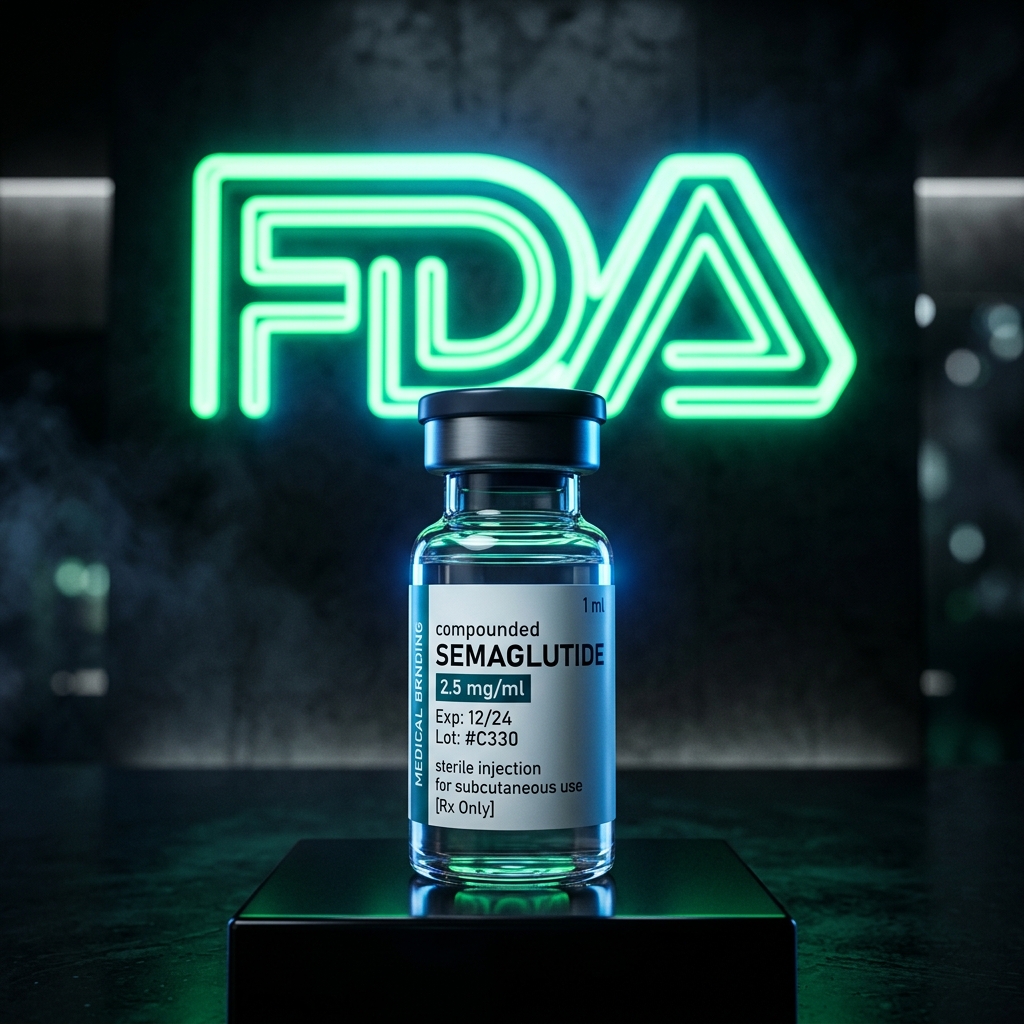
On April 30, 2026, the FDA dropped a regulatory bombshell on the medical weight loss industry. In a landmark proposal, the agency announced its intention to exclude semaglutide, tirzepatide, and liraglutide from the 503B bulks list. If finalized, this ruling will fundamentally alter the landscape of medical weight loss, effectively banning large-scale outsourcing facilities from manufacturing these life-changing GLP-1 medications from bulk drug substances.
For millions of Americans who rely on compounded versions of Semaglutide and Tirzepatide for metabolic health, this news has triggered panic, confusion, and fear. Will you lose access to your medication? Are you going to be forced back into a retail pharmacy system that charges upwards of $1,300 per month? Is your current medication even legal?
The compounding boom that began in 2023 was driven by unprecedented national shortages of branded drugs like Wegovy and Zepbound. But as supply chains recovered and the FDA formally declared these shortages resolved in February 2025, the legal framework that permitted mass compounding vanished. What followed was a wave of warning letters in March 2026, leading directly to this unprecedented federal proposal.
In this comprehensive, clinical deep dive, we will dissect the FDA's regulatory framework, explore the critical differences between 503A and 503B pharmacies, outline the exact timeline of the federal crackdown, and provide you with a bulletproof consumer protection checklist to ensure your treatment remains both safe and strictly compliant with federal law.
Navigate the Regulatory Changes Safely
Don't risk your health or your wallet on non-compliant pharmacies. Work with a fully licensed, 50-state compliant clinical weight loss program with no hidden fees.
Check Your EligibilityThe Regulatory Architecture: Understanding 503A vs. 503B
To truly comprehend the magnitude of the FDA's proposed ban, we must first decipher the complex regulatory architecture that governs pharmaceutical compounding in the United States. Following the catastrophic 2012 New England Compounding Center meningitis outbreak, Congress passed the Drug Quality and Security Act (DQSA), which created a stark bifurcation in compounding regulation: Section 503A and Section 503B.
Section 503A: Traditional Patient-Specific Compounding
Section 503A governs traditional compounding pharmacies. These facilities operate on a fundamental principle: they must compound medications based on a valid, patient-specific prescription to fulfill a documented clinical need. For example, if a patient is severely allergic to a specific inactive dye or preservative found in commercial Wegovy, a 503A pharmacist can legally formulate a pure semaglutide injection without that allergen. 503A pharmacies are heavily regulated by individual State Boards of Pharmacy and must adhere to the stringent guidelines set forth by the United States Pharmacopeia (USP), specifically USP Chapter <795> for non-sterile compounding and Chapter <797> for sterile injectable compounding.
Crucially, 503A pharmacies cannot compound large batches of drugs "for office use" to be kept on clinic shelves. Every vial produced must be tied directly to a specific patient's prescription. Furthermore, they are generally restricted from compounding "essentially copies" of commercially available drugs unless there is a specific medical reason or a declared national shortage.
Section 503B: Outsourcing Facilities
Section 503B created a completely different class of facility: the "outsourcing facility." These are massive, industrial-scale compounding operations designed to manufacture huge batches of sterile drugs to supply hospitals and massive clinical networks. Unlike 503A pharmacies, 503B facilities do not require patient-specific prescriptions. They can mass-produce vials and ship them in bulk.
Because of their massive scale and the lack of individual prescriptions, 503B facilities bypass state boards and are regulated directly by the FDA. They must comply with Current Good Manufacturing Practice (cGMP) requirements—the exact same rigorous standards required of multi-billion-dollar pharmaceutical titans like Novo Nordisk and Eli Lilly. However, there is a catch: 503B facilities can only compound using bulk drug substances that appear on a specific, FDA-approved "503B bulks list."
The core of the FDA's April 30, 2026 proposal specifically targets 503B outsourcing facilities. After evaluating the nomination of GLP-1 receptor agonists, the agency determined there is "no demonstrated clinical need" to compound these medications from bulk substances when FDA-approved, commercially available alternatives like Wegovy and Zepbound exist. This proposal aims to permanently shut down the industrial-scale compounding pipeline of GLP-1s.
The Shortage Era and the Wild West of Telehealth
How did we reach a point where millions of Americans were relying on compounded GLP-1s? The answer lies in the FDA Drug Shortages list. Under federal law, when a brand-name drug is officially listed as "currently in shortage," the restrictions on compounding "essentially copies" of that drug are temporarily lifted. This is a vital public health mechanism designed to ensure patients do not go without necessary medications when manufacturers fail to meet demand.
Between late 2023 and early 2025, the demand for metabolic interventions skyrocketed to unprecedented levels. The manufacturing infrastructure for the complex, single-use auto-injector pens used by branded GLP-1s completely collapsed under the pressure. As a result, the FDA placed both semaglutide and tirzepatide on the national shortage list. This designation legally opened the floodgates.
Practically overnight, a "wild west" telehealth ecosystem emerged. Thousands of med-spas, digital clinics, and direct-to-consumer websites capitalized on the shortage exemption, partnering with compounding pharmacies to mass-produce and distribute GLP-1s directly to patients' doors. While many operated ethically, a dangerous subset prioritized profit over patient safety.
The Crackdown: Warning Letters and the End of the Shortage
The era of unchecked compounding ended abruptly in February 2025. After massive supply chain investments by pharmaceutical manufacturers, the FDA officially declared the national semaglutide shortage resolved. With the brand-name drugs once again widely available, the legal shield that protected mass compounding vanished instantly.
In the aftermath, the FDA initiated a severe, highly coordinated crackdown. In March 2026, the agency issued dozens of warning letters to telehealth companies and pharmacies that continued to market compounded GLP-1s illegally. The violations were alarming. Regulators discovered clinics prescribing "semaglutide sodium" and "semaglutide acetate"—unapproved salt formulations that have never undergone rigorous clinical testing and are drastically different from the FDA-approved base molecule.
Understanding the Severe Safety Risks of Illicit Compounding
The FDA's intervention is not simply bureaucratic overreach to protect pharmaceutical monopolies; it is an urgent public health imperative. The uncontrolled compounding boom exposed hundreds of thousands of patients to severe, undocumented safety risks. Without the rigid oversight of the FDA approval process, patients utilizing unregulated compounding sources face profound dangers.
1. Substandard Active Pharmaceutical Ingredients (APIs)
The most alarming risk involves the sourcing of the active ingredient itself. Legitimate pharmacies use pure semaglutide or tirzepatide base. However, FDA warning letters revealed that many illicit pharmacies were importing raw, unverified peptide powders from overseas chemical suppliers, often labeled "for research purposes only." Worse, they utilized salt forms (semaglutide sodium) which are not therapeutically equivalent and pose unknown long-term risks to human physiology.
2. Catastrophic Dosing and Concentration Errors
Branded GLP-1 medications utilize pre-filled, single-use, dose-controlled auto-injectors that make accidental overdosing practically impossible. In contrast, compounded versions require the patient to manually draw the medication from a multi-dose vial using insulin syringes. The FDA received thousands of adverse event reports detailing patients who misunderstood the concentration mathematics and accidentally injected up to ten times their intended dose. This resulted in severe hypoglycemia, intractable vomiting, severe dehydration, and emergency room hospitalizations.
3. Sterility and Contamination Failures
Injectable medications must be perfectly sterile. If a compounding facility fails to maintain stringent USP <797> sterile environments, they risk introducing bacterial or fungal pathogens directly into the medication. Injecting contaminated fluid directly into subcutaneous tissue can cause severe, life-threatening systemic infections and abscesses.
Access Safe, Clinician-Managed Care
Don't guess with your dosing or medication source. TelehealthFX provides comprehensive clinical oversight, 1-on-1 onboarding, and transparent pricing.
Start Your EvaluationThe Consumer Protection Checklist: Spotting the 7 Red Flags
With the FTC launching major enforcement actions against several telehealth providers for deceptive practices, hidden fees, and illegal compounding, it is imperative to act as an informed consumer. If you are exploring telehealth weight loss options in 2026, you must protect your health and your finances. We have developed this 8-point consumer protection checklist to help you identify the red flags of an illicit operation.
- Hidden Membership Fees: The most common predatory tactic. Platforms lure patients in with a low advertised medication cost (e.g., "$99/month"), but bury a mandatory, recurring $135+ monthly subscription fee in the fine print. At TelehealthFX, we demand radical transparency: the price of the medication includes the clinical care. There are zero hidden membership fees.
- The "Sodium" or "Acetate" Trap: If a clinic or pharmacy states they use semaglutide sodium, terminate the process immediately. These are unapproved salt formulations that pose massive safety risks.
- Automated "Chatbot" Prescriptions: GLP-1s are serious metabolic hormones that require genuine clinical oversight. If you never interact with a real, licensed healthcare provider and your prescription is rubber-stamped by an algorithm, you are using a dangerous prescription mill.
- No Licensing Transparency: A legitimate telehealth platform operates legally and transparently across all 50 states, explicitly listing the credentials of its medical directors and pharmacy partners.
- Zero Onboarding or Ongoing Support: GLP-1 therapy dramatically alters your GI tract and metabolism. You require 1-on-1 onboarding support to manage side effects, adjust dosages, and integrate dietary changes. A platform that ships a vial and disappears is clinically negligent.
- Ignoring Contraindications: Patients with a personal or family history of medullary thyroid carcinoma or Multiple Endocrine Neoplasia syndrome type 2 (MEN 2) are absolutely contraindicated for GLP-1 therapy. A legitimate provider will conduct rigorous medical screening.
- Opaque Pharmacy Sourcing: You have an absolute right to know exactly where your medication is manufactured. The telehealth platform must provide total transparency regarding the 503A pharmacy's location, state licensure, and third-party sterility testing protocols.
Your Compliant Options Moving Forward in 2026
As the FDA continues its crackdown on 503B mass compounding and illegal salt formulations, the landscape is rapidly consolidating. What are your options for accessing life-changing metabolic treatments safely and legally?
For patients who meet the strict clinical criteria, the traditional healthcare system remains an option. However, securing brand-name Wegovy or Zepbound is an uphill battle. Without elite commercial insurance coverage, out-of-pocket retail costs remain staggeringly high—often exceeding $1,000 to $1,300 per month. The bureaucratic nightmare of prior authorizations, step-therapy requirements, and high deductibles continues to block access for millions.
The superior alternative is a modernized, compliance-first telehealth ecosystem like TelehealthFX. By operating strictly within the legal bounds of patient-specific prescribing, partnering exclusively with verified U.S. licensed 503A pharmacies, and refusing to engage in hidden subscription fees, TelehealthFX provides concierge-level clinical care.
TelehealthFX doesn't just offer medication; they offer a comprehensive metabolic strategy. Alongside transparently priced GLP-1 therapies, patients have access to NAD+ injections to restore mitochondrial energy and Sermorelin peptide therapy to preserve lean muscle mass during extreme fat loss. It is a complete, clinically sound approach to longevity and weight management.
Frequently Asked Questions (FAQ)
Is compounded semaglutide still legal in 2026?
Yes, under certain strict conditions. The FDA's proposal targets 503B outsourcing facilities, preventing them from compounding GLP-1s in bulk. However, 503A traditional compounding pharmacies can still legally prepare patient-specific medications if there is a documented clinical need, such as an allergy to a specific ingredient in the branded product.
What happens if the FDA bans my compounded medication?
If you are currently receiving a compounded GLP-1 from a source that is forced to stop production, you will need to transition to a compliant telehealth provider or obtain a branded prescription (like Wegovy or Zepbound) through your primary care physician. TelehealthFX specializes in guiding patients through compliant, affordable options.
Why is the FDA cracking down on compounding pharmacies?
The FDA is prioritizing patient safety. They found 'no demonstrated clinical need' for bulk compounding of these drugs when FDA-approved versions are available. They also issued warning letters to pharmacies using unsafe ingredients like 'semaglutide sodium' instead of the approved base molecule.
Can I just use "Nature's Ozempic" instead?
"Nature's Ozempic" is a marketing term for Berberine. While berberine is a highly effective, natural AMPK activator that improves insulin sensitivity, it does not possess the powerful incretin hormone action of a true GLP-1 medication. It is an excellent supplement, but not a pharmaceutical equivalent for extreme weight loss.
Ready for Transparent, Clinical Weight Loss?
Your health is too important to risk on shady compounding workarounds. Experience a comprehensive, fully compliant metabolic program with 1-on-1 support and zero hidden fees.
Start GLP-1 TherapyAcademic References & Clinical Citations
- U.S. Food and Drug Administration. (2026, April 30). FDA Proposes to Exclude Certain Peptides from the 503B Bulks List. Federal Register. https://www.federalregister.gov/documents/2026
- U.S. Food and Drug Administration. (2026, March 15). Warning Letters Issued to Compounders of Unapproved Semaglutide Products. FDA Press Announcements. https://www.fda.gov/news-events/press-announcements/
- United States Pharmacopeia. (2023). USP General Chapter <797> Pharmaceutical Compounding—Sterile Preparations. https://www.usp.org/compounding/general-chapter-797