
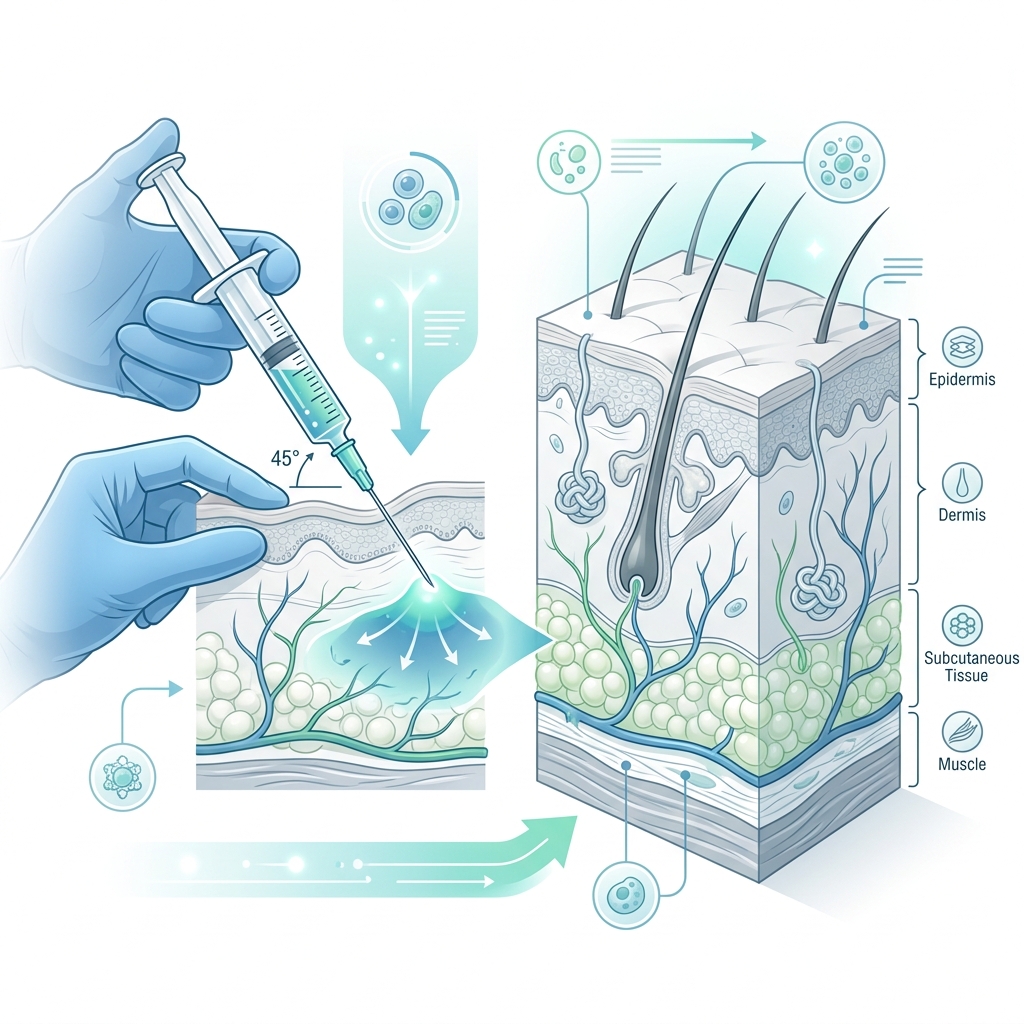
Injection site reactions (ISRs) affect 5–10% of GLP-1 patients and range from trivial (minor redness) to concerning (persistent lumps). While rarely dangerous, ISRs cause significant anxiety — especially for patients new to self-injection. Understanding the types, causes, and prevention strategies eliminates the guesswork and keeps your therapy on track.
The good news: unlike the GI side effects that get all the attention, injection site reactions are almost entirely preventable with proper technique. This guide covers everything: what's normal, what's not, injection technique optimization, and when to call your clinician.
Types of Injection Site Reactions
| Reaction | Appearance | Frequency | Duration | Concern Level |
|---|---|---|---|---|
| Redness (erythema) | Pink/red circle around injection site | 5–8% | 24–48 hours | Normal |
| Bruising | Blue/purple mark at site | 8–12% | 5–10 days | Normal |
| Small lump (nodule) | Pea-sized firm bump under skin | 3–5% | 1–2 weeks | Monitor |
| Itching (pruritus) | Localized itch around site | 2–4% | 24–72 hours | Normal |
| Lipodystrophy | Dent or thickening at injection site | Rare | Months–permanent | Prevent |
| Infection (cellulitis) | Expanding redness, warmth, fever | Very rare | Requires antibiotics | Urgent care |
The 8-Point Injection Technique Protocol
Proper technique prevents 90%+ of injection site reactions. Follow this protocol for every injection:
- 1. Room-temperature medication: Remove your pen or vial from the refrigerator 15–30 minutes before injection. Cold medication causes more pain and local irritation. See our storage guide for proper handling.
- 2. Clean the site: Use an alcohol swab. Allow to dry completely (30 seconds). Injecting through wet alcohol pushes it into tissue — causing stinging.
- 3. Rotate injection sites systematically: Use a rotation pattern across abdomen (2 inches from navel), front of thighs, and back of upper arms. Never inject in the same spot twice within 4 weeks. Repeated same-site injection causes lipodystrophy.
- 4. Pinch technique: Pinch a 2-inch fold of skin. Insert the needle at 90° into the fold. This ensures subcutaneous (not intramuscular) delivery.
- 5. Inject slowly: Depress the plunger slowly over 5–10 seconds. Rapid injection creates a bolus that causes localized swelling and pain.
- 6. Hold for 10 seconds: After full injection, keep the needle in place for 10 seconds before withdrawing. This prevents medication from leaking back out (backflow).
- 7. Do NOT rub the site: Rubbing disperses medication too quickly and increases bruising. Gentle pressure with a cotton ball is fine if bleeding occurs.
- 8. Use a new needle every time: For compounded vials, never reuse syringes. Reused needles are blunt, causing more tissue trauma. See our injection timing guide for optimal scheduling.
Managing Common Reactions
Bruising
Most bruising is caused by hitting a small capillary. It is cosmetic and painless. To minimize: avoid injecting near visible veins, avoid NSAIDs (ibuprofen, aspirin) for 24 hours before injection (they thin blood), and apply gentle pressure immediately after withdrawing the needle. If you bruise easily, mention this to your clinician — it may indicate vitamin K deficiency or a coagulation issue worth investigating.
Small Lumps (Nodules)
Pea-sized lumps that appear after injection are usually localized medication deposits. They resolve within 1–2 weeks as the medication absorbs. Causes: injecting too quickly, not reaching subcutaneous tissue (too shallow), or cold medication. If a lump persists beyond 3 weeks, hardens, or becomes painful, contact your clinician. Persistent lumps may indicate improper injection depth or a localized immune reaction.
Lipodystrophy Prevention
Lipodystrophy — visible dents (lipoatrophy) or thickening (lipohypertrophy) — is caused by repeated injection in the same anatomical location. It is entirely preventable with proper site rotation. Use a rotation log or diagram on your phone. Patients using compounded semaglutide vials should be particularly vigilant since they choose their own injection site each week.
Injection Support Included in Your Protocol
TelehealthFX clinicians guide you through proper technique and troubleshoot any reactions. From $199/month. HSA/FSA accepted.
Start Your EvaluationWhen to Seek Medical Attention
- Expanding redness with warmth and fever: Possible cellulitis (infection). Requires antibiotics. Contact your clinician or go to urgent care.
- Hives or widespread rash after injection: Possible allergic reaction. If accompanied by swelling of face/throat or difficulty breathing, call 911.
- Persistent lump growing larger over weeks: Requires evaluation to rule out abscess or granuloma.
Frequently Asked Questions
Where is the least painful injection site?
The abdomen (2+ inches from navel) is generally the least painful site due to higher subcutaneous fat and fewer nerve endings. Thighs are second. Upper arms are most painful and hardest to self-inject — many patients skip arms entirely.
Does the injection site affect how well the medication works?
No. Semaglutide absorption is equivalent from abdomen, thigh, and upper arm. Choose based on comfort and rotation schedule.
Can I use a numbing cream before injection?
Yes — topical lidocaine cream (4–5%) applied 20–30 minutes before injection effectively numbs the site. This is particularly helpful for needle-anxious patients during the first few weeks.
Guided Injection. Full Clinical Support. From $199/mo.
FDA-registered pharmacies. HSA/FSA accepted.
Get StartedReferences
- Novo Nordisk. (2024). Ozempic prescribing information — injection site reactions. FDA Label.
- Frid, A. H., et al. (2016). New insulin delivery recommendations. Mayo Clinic Proceedings, 91(9), 1231–1255.
- Blanco, M., et al. (2013). Injection site lipodystrophy in insulin-treated patients: a literature review. Diabetes & Metabolism, 39(5), 445–453.