
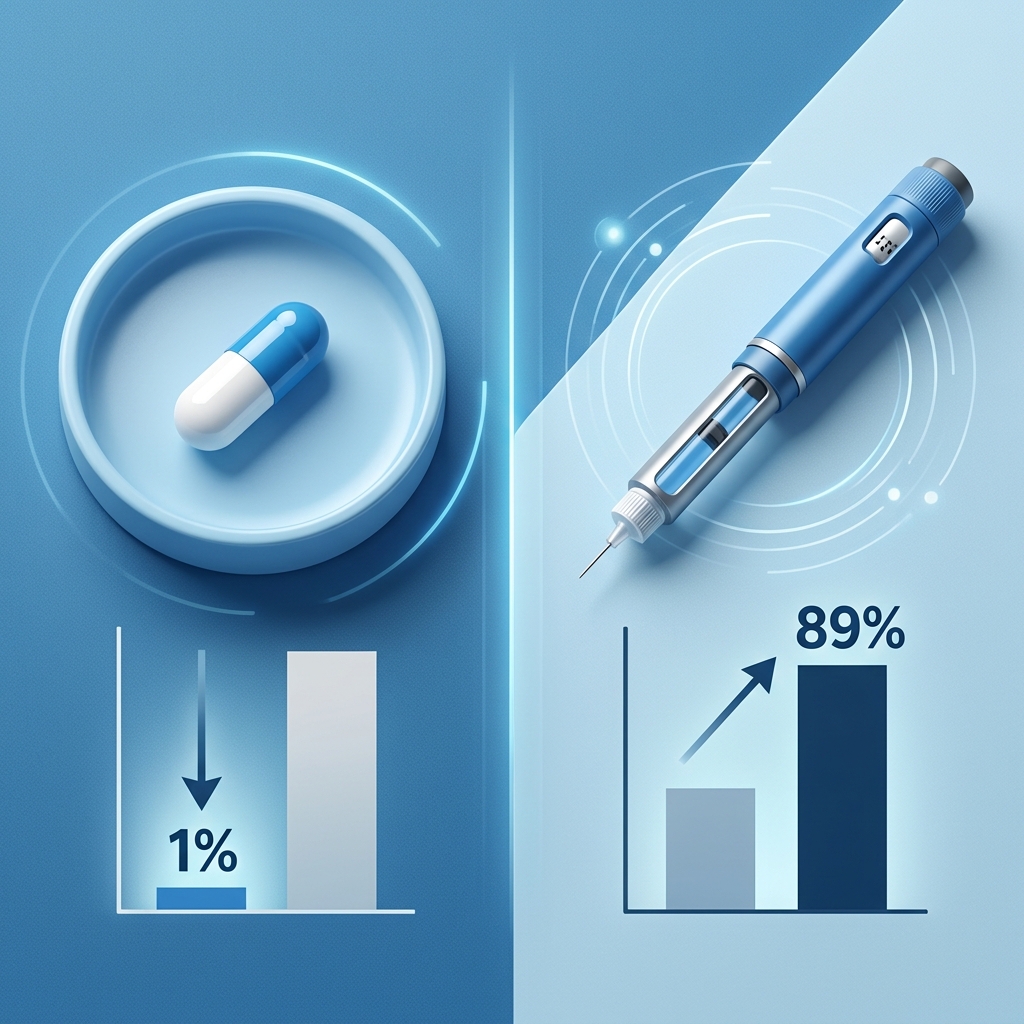
If you hate needles, oral semaglutide sounds like the perfect solution: same drug, no injection. But the clinical reality is far more nuanced. Oral semaglutide (Rybelsus) has less than 1% bioavailability — meaning 99%+ of the drug you swallow is destroyed by stomach acid and never reaches your bloodstream. Injectable semaglutide has ~89% bioavailability. This fundamental pharmacokinetic difference drives everything: efficacy, cost, convenience, and clinical outcomes.
Head-to-Head Comparison
| Factor | Oral (Rybelsus) | Injectable (Wegovy/Compounded) | Winner |
|---|---|---|---|
| Bioavailability | <1% | ~89% | Injectable |
| Weight loss (STEP/OASIS) | ~15% (high dose) | 14.9% (proven) | Comparable at max dose |
| Dosing frequency | Daily (every morning) | Once weekly | Injectable |
| Fasting requirement | 30 min fast + 4oz water only | None | Injectable |
| Brand cost (no insurance) | $935–$1,000/mo | $1,350/mo (Wegovy) | Oral (slightly) |
| Compounded injectable cost | N/A (not compounded) | $199/mo | Injectable |
| GI side effects | Higher nausea rate | Moderate | Injectable |
| Cardiovascular data | Limited for weight loss dose | SELECT trial (20% MACE reduction) | Injectable |
The Bioavailability Problem: Why 99% of Your Pill Gets Destroyed
Semaglutide is a peptide — a chain of amino acids. When you swallow a peptide, your stomach acid and digestive enzymes immediately begin breaking it apart, just like they break apart the protein in your food. This is why injectable semaglutide has ~89% bioavailability while oral has <1%.
To compensate, Novo Nordisk developed SNAC (sodium N-[8-(2-hydroxybenzoyl) amino] caprylate) — a permeation enhancer that temporarily raises stomach pH and facilitates absorption through the gastric mucosa. But this technology has strict requirements:
- Empty stomach: You must fast overnight, then take the pill with no more than 4oz of plain water.
- 30-minute post-dose fast: No food, drink, or other medications for 30 minutes after swallowing.
- No lying down: Remain upright for 30 minutes to prevent esophageal irritation.
- Daily compliance: Unlike the once-weekly injection, you must do this every single morning with perfect timing.
For shift workers with irregular schedules, this daily fasting requirement can be extremely difficult. A once-weekly injection eliminates this friction entirely. For a deeper mechanism analysis, see our oral semaglutide mechanism guide.
Cost: The Decisive Factor
When you compare brand-name to brand-name, oral Rybelsus is actually slightly cheaper than injectable Wegovy ($935 vs. $1,350/month). But this comparison is irrelevant for most patients because compounded injectable semaglutide is available for $199/month — see our complete cost guide.
Oral semaglutide cannot be compounded because the SNAC delivery technology is patent-protected. This means oral is locked at brand-name pricing ($935+), while injectable is available at compounded pricing ($199). The cost gap is $736/month — $8,832/year.
For additional savings strategies, see our HSA/FSA guide and tax deduction guide.
Same Drug. Higher Absorption. 80% Less Cost.
Compounded injectable semaglutide from $199/mo vs. $935/mo for oral. Once weekly vs. daily. 89% absorbed vs. <1%.
Start Your EvaluationWhen Oral Might Make Sense
Despite the clear advantages of injectable, there are limited scenarios where oral semaglutide could be appropriate:
- Severe needle phobia: If injection anxiety is genuinely preventing you from starting treatment — not mild discomfort, but clinical phobia that cannot be managed with auto-injectors. (Note: GLP-1 needles are 4mm subcutaneous — smaller than most blood draw needles.)
- Insurance coverage: Some insurance plans cover Rybelsus for type 2 diabetes but not Wegovy for weight loss. If your insurer covers oral but not injectable, the cost equation flips. See our insurance coverage guide.
- Travel restrictions: Oral medication does not require refrigeration or carrying injection supplies. But semaglutide pens are stable at room temperature for 56 days, making this advantage minimal.
For most patients — especially those paying out-of-pocket — injectable compounded semaglutide at $199/month is the clear clinical and financial winner. If you are considering tirzepatide instead, see our decision guide.
Frequently Asked Questions
Is oral semaglutide FDA-approved for weight loss?
Rybelsus (oral semaglutide 3mg, 7mg, 14mg) is FDA-approved for type 2 diabetes. A higher-dose oral formulation (25mg and 50mg) has shown strong weight loss results in the OASIS trials and is moving toward FDA approval for obesity. However, this high-dose oral formulation will likely be priced at $1,000+/month — still far above compounded injectable pricing.
Are the side effects different?
Oral semaglutide tends to cause more nausea because the drug interacts directly with the GI tract before absorption. Injectable bypasses the stomach entirely and is generally better tolerated. Both share common side effects (nausea, constipation, diarrhea) that typically resolve during the first 4–8 weeks of titration.
What about the next-gen oral GLP-1 drugs?
Orforglipron (Eli Lilly) is a non-peptide oral GLP-1 that does not require SNAC technology and has higher bioavailability. It is in Phase 3 trials and could launch in 2027–2028. This could genuinely disrupt the market. See our next-gen GLP-1 pipeline guide.
89% Absorbed. Once Weekly. From $199/mo.
Compounded injectable semaglutide. Clinician-guided. No daily fasting protocol. Cancel anytime.
Get StartedReferences
- Knop, F. K., et al. (2023). Oral semaglutide 50mg taken once daily in adults with overweight or obesity (OASIS 1). The Lancet, 402(10403), 705–719.
- Buckley, S. T., et al. (2018). Transcellular stomach absorption of a derivatized glucagon-like peptide-1 receptor agonist. Science Translational Medicine, 10(467).
- Wilding, J. P. H., et al. (2021). Once-weekly semaglutide in adults with overweight or obesity (STEP 1). NEJM, 384(11), 989–1002.