
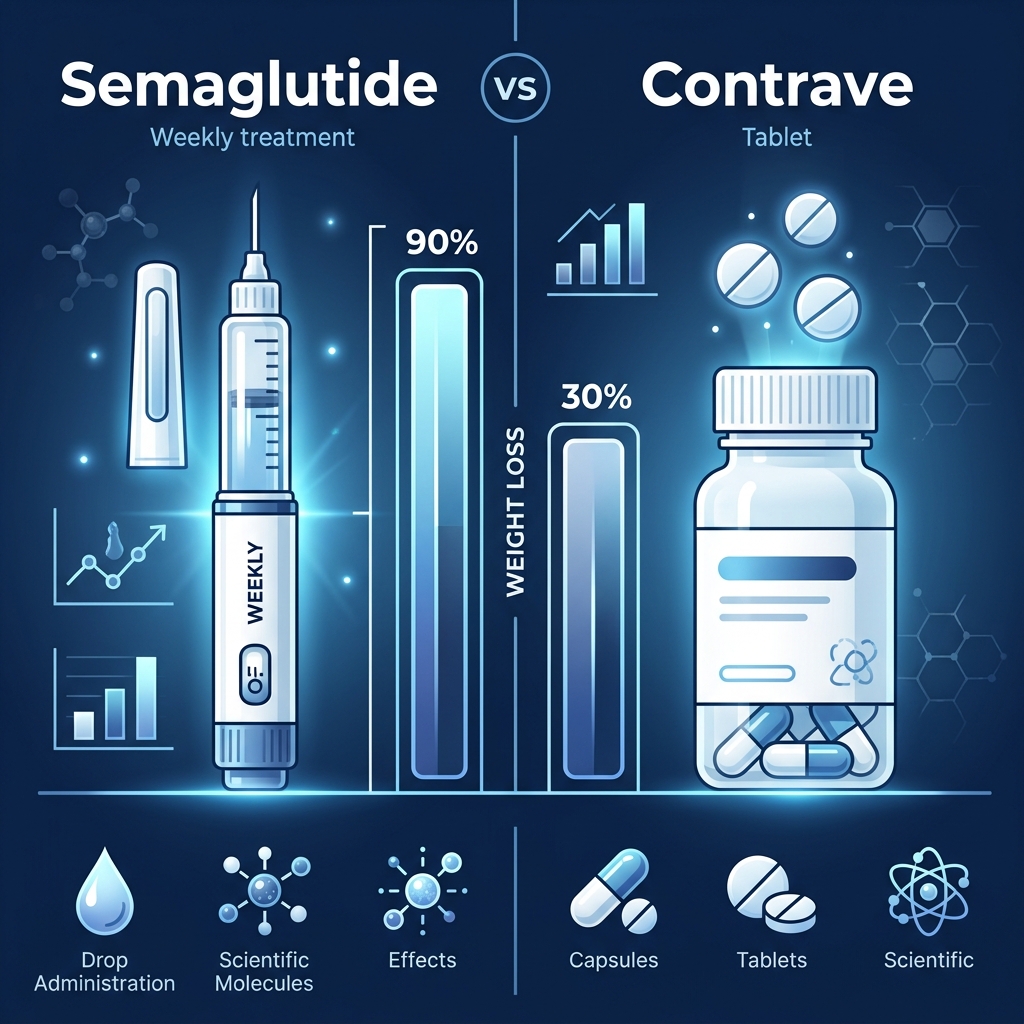
Contrave (naltrexone/bupropion) and semaglutide (Wegovy/Ozempic) represent two fundamentally different pharmacological approaches to weight loss. Contrave targets the brain's reward and appetite centers through dual opioid-antagonist/dopamine-norepinephrine reuptake inhibition. Semaglutide mimics the natural GLP-1 hormone to slow gastric emptying and suppress appetite at the hypothalamic level. The efficacy gap is enormous — but so is the cost gap. Here is the complete comparison to help you make the right decision.
Head-to-Head Comparison
| Factor | Semaglutide 2.4mg | Contrave |
|---|---|---|
| Avg weight loss | 15–17% body weight | 5–8% body weight |
| Mechanism | GLP-1 receptor agonist | Naltrexone + Bupropion |
| Administration | Weekly injection | Daily oral pills (2x/day) |
| Brand cost/mo | $1,300+ (Wegovy) | $400–$600 |
| Compounded cost/mo | $199–$299 | N/A (no compounded version) |
| Cardiovascular data | SELECT: 20% MACE reduction | LIGHT: No CV benefit; BP concerns |
| Top side effects | Nausea, constipation, diarrhea | Nausea, headache, insomnia, dry mouth |
| Food noise reduction | Dramatic | Moderate |
| Mental health effects | Generally positive (reduced food anxiety) | Bupropion has antidepressant effects; seizure risk |
The efficacy difference is stark: semaglutide produces 2–3x the weight loss of Contrave in clinical trials. The SELECT trial demonstrated a 20% reduction in major adverse cardiovascular events — Contrave has no equivalent cardiovascular benefit. For patients where cost is less of a concern, semaglutide is the clearly superior medication. However, Contrave has a legitimate role for specific patient populations.
When Contrave May Be the Right Choice
Despite its lower efficacy, Contrave may be appropriate in specific clinical scenarios:
- Needle phobia: Contrave is an oral medication. For patients who absolutely cannot tolerate injections and are unwilling to try oral semaglutide, Contrave is a reasonable alternative.
- Depression comorbidity: Bupropion (one of Contrave's components) is an FDA-approved antidepressant. For patients with concurrent depression and obesity, Contrave addresses both conditions simultaneously. GLP-1 has emerging evidence for mental health benefits, but is not approved for depression.
- Smoking cessation: Bupropion is also FDA-approved for smoking cessation (as Zyban). If a patient needs both weight loss and smoking support, Contrave provides dual benefit.
- GLP-1 contraindications: Personal or family history of medullary thyroid cancer or MEN2 syndrome contraindicates GLP-1 use. See our thyroid risk analysis.
When Semaglutide Is Clearly Superior
For the majority of weight loss patients, semaglutide is the superior choice:
- Significant weight loss needed (30+ lbs): Contrave's 5–8% weight loss is insufficient for patients with BMI 35+. Semaglutide's 15–17% is transformative.
- Type 2 Diabetes or prediabetes: Semaglutide has powerful glucose-lowering effects. Contrave does not. See our diabetes guide and prediabetes prevention articles.
- Cardiovascular risk: The SELECT trial is definitive. No weight loss medication has better cardiovascular data than semaglutide.
- PCOS: GLP-1 directly addresses the insulin resistance driving PCOS. Contrave does not.
- Fatty liver disease: Semaglutide produces 59% MASH resolution. Contrave has no liver benefit data.
- Cost (compounded): Compounded semaglutide from $199/month is actually cheaper than brand Contrave ($400–$600/month).
2–3x the Weight Loss. From $199/mo.
Compounded semaglutide delivers 15–17% weight loss vs Contrave's 5–8% — at a lower price point. HSA/FSA accepted.
Start Your EvaluationSafety Comparison: Side Effects and Contraindications
Both medications have significant side effect profiles, but the nature of those side effects differs dramatically:
Semaglutide side effects are primarily gastrointestinal: nausea (44%), diarrhea (30%), constipation (24%), and vomiting (24%). These are dose-dependent and typically resolve during the first 8–12 weeks. Rare but serious risks include pancreatitis and gallbladder disease.
Contrave side effects are primarily neurological: nausea (33%), headache (18%), insomnia (9%), dizziness (10%), and dry mouth (8%). The critical safety concern is seizure risk: bupropion lowers the seizure threshold. Contrave is absolutely contraindicated in patients with seizure disorders, eating disorders (bulimia/anorexia), alcohol withdrawal, or those taking MAO inhibitors. Contrave also carries an FDA black-box warning for suicidal thoughts and behavior in patients under 25.
For most patients, semaglutide's GI-focused side effects are more tolerable and more manageable than Contrave's CNS effects. The availability of slow dose titration protocols for semaglutide provides additional safety margin. See our complete medications ranking for how both compare against the full field.
Can You Take Contrave and Semaglutide Together?
There is no formal pharmacological interaction between Contrave and semaglutide — they act through completely different receptor systems. Some obesity specialists do prescribe them in combination for treatment-resistant cases. However, this is off-label, not well-studied, and doubles the side effect burden. If you have plateaued on one medication, switching to tirzepatide is a better-studied strategy than adding a second drug. Always discuss combination therapy with your clinician.
Frequently Asked Questions
Is Contrave a GLP-1 medication?
No. Contrave is a combination of naltrexone (an opioid antagonist) and bupropion (a norepinephrine-dopamine reuptake inhibitor). It works in the brain, not the gut. GLP-1 medications (semaglutide, tirzepatide, liraglutide) work through GLP-1 receptor activation in the gut, pancreas, and hypothalamus.
Why would my doctor prescribe Contrave instead of Ozempic?
Common reasons: needle phobia, concurrent depression (bupropion treats both), smoking cessation needs, GLP-1 contraindications (thyroid cancer history), or insurance covering Contrave but not GLP-1.
Is Contrave cheaper than semaglutide?
Brand Contrave ($400–$600/month) is cheaper than brand Wegovy ($1,300+). However, compounded semaglutide ($199–$299/month) is actually cheaper than Contrave — with 2–3x the efficacy.
Superior Efficacy. Lower Cost. From $199/mo.
Compounded semaglutide from $199/mo. Tirzepatide from $349/mo.
Get StartedReferences
- Wilding, J. P. H., et al. (2021). STEP 1 Trial — Semaglutide 2.4mg. NEJM, 384(11), 989–1002.
- Greenway, F. L., et al. (2010). Effect of naltrexone plus bupropion on weight loss (COR-I). The Lancet, 376(9741), 595–605.
- Lincoff, A. M., et al. (2023). Semaglutide and cardiovascular outcomes in obesity (SELECT). NEJM, 389(24), 2221–2232.